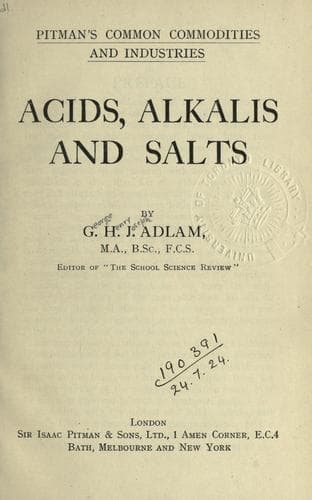
Acids, Alkalis and SaltsAdlam, George Henry Joseph
Science
Acids, Alkalis and Salts
Adlam, George Henry Joseph
Acids; Alkalies; Salts
As an example of the neutralization of acids by carbonates, we may
mention here a practical sugar saving device. Unripe fruit is very sour
because it contains certain vegetable acids dissolved in the juice.
These acids are not affected by boiling; and, therefore, to make a dish
of stewed fruit palatable, it is necessary to add sugar in quantity
sufficient to mask the sour taste. If a pinch of bicarbonate of soda is
added to neutralize the acid, far less sugar will be necessary for
sweetening.
Insoluble Salts. The methods given above apply only to those salts which
are soluble in water. Insoluble salts are obtained by mixing two
solutions, the one containing a soluble salt of the metal, and the
other, a soluble salt of the acid or the acid itself.
The formation of an insoluble salt by the interaction of two soluble
substances is well illustrated in the preparation of Burgundy mixture,
the most effectual remedy yet proposed for checking the spread of potato
disease. This mixture contains copper carbonate, that is, the copper
salt of carbonic acid. For its preparation we require copper sulphate
and sodium carbonate (washing soda), a soluble carbonate. When these two
substances, dissolved in separate portions of water, are mixed, copper
carbonate is formed as a pale blue solid which is in such a state of
fine subdivision that it remains suspended in the solution of sodium
sulphate, the other product of the reaction.
The change is represented diagrammatically below. Each circle represents
the atom or a group of atoms named therein. At the moment of mixing,
these groups undergo re-arrangement.
Bordeaux mixture, which some gardeners prefer, is a similar preparation
containing copper hydroxide instead of copper carbonate. It is made by
mixing clear lime water (a soluble hydroxide) with copper sulphate.
[Illustration: Fig. 1]
Elements and Compounds. It is scarcely possible to discuss chemical
processes without having from time to time to use terms which are not in
everyday use. A few preliminary definitions and explanations of terms
which will be frequently used may serve to simplify descriptions, and
render it unnecessary to encumber them with purely explanatory matter.
Among the many different kinds of materials known, which in the
aggregate amount to several hundreds of thousands, there are about
ninety substances which up to the present time have not been broken up
into simpler kinds. These primary materials are called “elements,” the
remainder being known as “compounds.”
The following is a list of the commonest of these elements, together
with the symbols by which they are represented in Chemistry.
Public-domain text, read in full here on John Shaqi.
Reviews
Reviews
No reviews yet
Be the first to share your thoughts on this work.
Join the Discussion
Join the discussion
Sign in to leave a comment or review.
Sign InorCreate an account