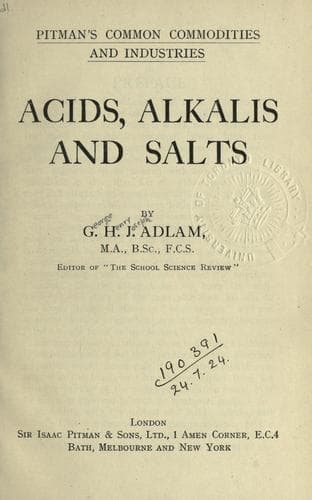
Acids, Alkalis and SaltsAdlam, George Henry Joseph
Science
Acids, Alkalis and Salts
Adlam, George Henry Joseph
Acids; Alkalies; Salts
In the Haber process, nitrogen obtained by the fractional distillation
of liquid air is mixed with three times its volume of hydrogen, and this
mixture is heated to between 500°C. and 700°C. under a pressure of 150
atmospheres (nearly 1 ton to the square inch) and in the presence of a
contact agent. Under these conditions, nitrogen and hydrogen combine to
form ammonia, which is condensed by passing the mixed gases into a
vessel cooled with liquid air, any unchanged nitrogen and hydrogen being
passed back again over the contact substance.
The problem of making ammonia from the air is closely connected with
that of making nitric acid from the same source. In some experiments the
two are combined, and ammonium nitrate is produced directly. Ammonia
made by the Haber process, or some modification, is mixed with
atmospheric oxygen and passed through platinum gauze heated to low
redness. This results in the formation of nitric oxide, which is further
oxidized by atmospheric oxygen; and finally, from a mixture of oxides of
nitrogen, water vapour, and ammonia, synthetic ammonium nitrate is
obtained.
CHAPTER X
ELECTROLYTIC METHODS
One of the most noteworthy developments of modern chemical industry has
been the increasing use of electricity as an agent for bringing about
changes in matter. This has followed naturally from the reduction in the
cost of electricity, due in great measure to the utilization of natural
sources of energy which for untold ages had been allowed to run to
waste.
This last achievement is likely to produce such a change in economic
conditions that it is worth while giving a little thought to what may be
called a newly-discovered asset of civilization. One example will make
this clear. In the bed of the Niagara river, which flows from Lake Erie
to Lake Ontario, there is a sudden drop of 167 ft. over which the water
rushes with tremendous force and expends its energy in producing heat
which cannot be utilized. This is a waste of energy, but it cannot be
circumvented because no method has yet been found to control the waters
of the Falls themselves. Nevertheless, by leading the head waters
through suitable channels from the high level to the low, it is possible
to use the energy to drive turbines, which, in their turn, drive dynamos
which produce the current. This is merely the conversion of the energy
of running water into electrical energy; and while the sun remains, this
supply of energy will be forthcoming in undiminished quantity, because
by the heat of the sun the water is lifted again as vapour, which
descends as rain to replenish the sources from which the Niagara flows.
Public-domain text, read in full here on John Shaqi.
Reviews
Reviews
No reviews yet
Be the first to share your thoughts on this work.
Join the Discussion
Join the discussion
Sign in to leave a comment or review.
Sign InorCreate an account