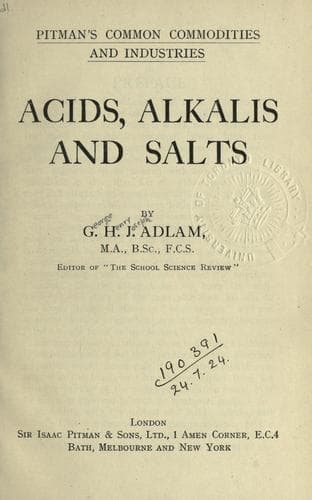
Acids, Alkalis and SaltsAdlam, George Henry Joseph
Science
Acids, Alkalis and Salts
Adlam, George Henry Joseph
Acids; Alkalies; Salts
METALS
Aluminium Al.
Antimony (_Stibium_) Sb.
Barium Ba.
Bismuth Bi.
Cadmium Cd.
Calcium Ca.
Chromium Cr.
Copper (_Cuprum_) Cu.
Gold (_Aurum_) Au.
Iron (_Ferrum_) Fe.
Lead (_Plumbum_) Pb.
Lithium Li.
Magnesium Mg.
Manganese Mn.
Mercury (_Hydrargyrum_) Hg.
Nickel Ni.
Platinum Pt.
Potassium (_Kalium_) K.
Silver (_Argentum_) Ag.
Sodium (_Natrium_) Na.
Strontium Sr.
Tin (_Stannum_) Sn.
Zinc Zn.
NON-METALS
Boron B.
Bromine Br.
Carbon C.
Chlorine Cl.
Fluorine F.
Hydrogen H.
Iodine I.
Nitrogen N.
Oxygen O.
Phosphorus P.
Silicon Si.
Sulphur S.
The first step in the building-up process consists of the union of a
metallic with a non-metallic element. Such compounds are binary
compounds, and are distinguished by the termination -ide added to the
name of the non-metallic element; for example, copper and oxygen unite
to form copper oxide, sodium and chlorine form sodium chloride, iron and
sulphur form iron sulphide or sulphide of iron.
A compound containing more than two elements is distinguished by the
termination -ate. Most salts fall within this category; thus we speak of
acetate of lead and chlorate of potash, also of sodium sulphate and
copper sulphate, the latter form being the more correct.
A difficulty arises when two bodies are composed of the same elements
combined in different proportions. Then we have to resort to other
distinguishing prefixes or suffixes. For this reason we meet with
sulphur_ous_ acid and sulphur_ic_ acid, the corresponding salts being
sulph_ites_ and sulph_ates_.
Crystals and Water of Crystallization. When a soluble salt is to be
recovered from its solution, the latter is reduced in bulk by
evaporation until, either by experience or by trial, it becomes evident
that the solid will be formed as the liquid cools. In some cases, when
time is not an important factor, evaporation is left to take place
naturally. Under either set of conditions, the substance generally
separates out in particles which have a definite geometrical form. These
are spoken of as crystals.
Public-domain text, read in full here on John Shaqi.
Reviews
Reviews
No reviews yet
Be the first to share your thoughts on this work.
Join the Discussion
Join the discussion
Sign in to leave a comment or review.
Sign InorCreate an account