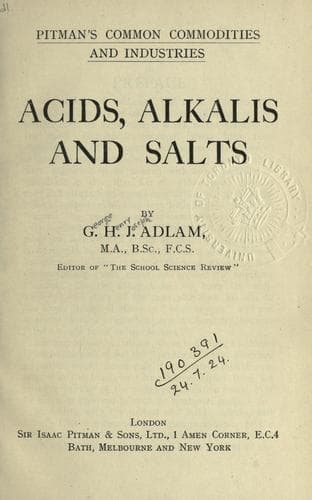
Acids, Alkalis and SaltsAdlam, George Henry Joseph
Science
Acids, Alkalis and Salts
Adlam, George Henry Joseph
Acids; Alkalies; Salts
Crystals often contain a definite percentage of water, called “water of
crystallization.” In washing soda, this combined water forms nearly 63
per cent. of the total weight; in blue vitriol, it is approximately 36
per cent. On being heated to a moderate temperature, the water is
expelled from the solid; the substance which is left behind is called
the anhydrous (that is, the waterless) salt.
CHAPTER II
SULPHURIC ACID AND SULPHATES
Key Industries. The importance of the chemical industries depends mainly
on the fact that they constitute the first step in a series of
operations by which natural products are adapted to our needs. The
materials which are found in earth, air, and water are both varied in
kind and abundant in quantity, but in their natural state they are not
generally available for immediate use. Moreover, very many substances
now deemed indispensable are not found ready formed in Nature.
The end product of the chemical manufacturer is often one of the primary
materials of some other industry. Soda ash and Glauber’s salt are
essential for making glass; soap could not be produced without caustic
alkali; the textile trade would be seriously handicapped if bleaching
materials, mordants, and dye-stuffs were not forthcoming. Considered in
this light, the preparation of chemicals is spoken of as a “key
industry.”
Furthermore, very few of these indispensable substances can be made
without using sulphuric acid. This acid is, on that account, just as
important to chemical industries as the products of these are to other
branches of trade. It may, therefore, be looked upon as a master key of
industrial life.
Primary Materials. The composition of sulphuric acid is not difficult to
understand. Air is mainly a mixture of oxygen and nitrogen; and when a
combustible body burns, it is because chemical action between the
material and oxygen is taking place. In this way, sulphur burns to
sulphur dioxide. This gas, dissolved in water, forms sulphur_ous_ acid,
which changes slowly to sulphur_ic_ acid by combination with more
oxygen. Hence, sulphur, oxygen, and water are the primary materials
required for making sulphuric acid.
Sulphur is the familiar yellow solid commonly known as brimstone. It is
found native in the earth, and is fairly abundant in certain localities,
notably in the neighbourhood of active and extinct volcanoes. Italy,
Sicily, Japan, Iceland, and parts of the United States are the principal
sulphur-producing countries. Though very plentiful and consequently
cheap, only a relatively small quantity of sulphuric acid is made
directly from native sulphur, because at the time when this industry was
started in England, restrictions were placed on the export of sulphur
from Sicily and, consequently, the plant which was then established was
adapted to the use of iron pyrites.
Public-domain text, read in full here on John Shaqi.
Reviews
Reviews
No reviews yet
Be the first to share your thoughts on this work.
Join the Discussion
Join the discussion
Sign in to leave a comment or review.
Sign InorCreate an account