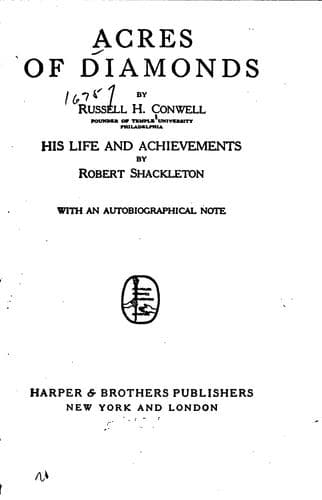
This stirring manifesto shows how to discover everything you need to succeed— where you least expect it.So begins one of the most famous speeches of the twentieth century, a talk that educator and minister Russell H. Conwell delivered before literally thousands of audiences before his death in 1925. In its printed version Acres of Diamonds reached millions of readers around the world. Conwell's great manifesto imparts one extraordinary lesson: All the wealth you could ever dream of, search for, or yearn after—in whatever form you wish for—exists right beneath your own feet. It is a message of determination, unconventional thinking, and positive living that came to influence a generation of motivational literature.The Success Classics edition of Acres of Diamonds also features two rare bonus works: Praying for Money and The Story of "Acres of Diamonds" by journalist Robert Shackleton.
He has a rueful appreciation of the humor of it, as he pictured the
scene; and one knows also that, in that little town of Lexington, where
Americans had so bravely faced the impossible, Russell Conwell also
braced himself to face the impossible. A pettier man would instantly
have given up the entire matter when those who were most interested
failed to respond, but one of the strongest features in Conwell’s
character is his ability to draw even doubters and weaklings into line,
his ability to stir even those who have given up.
“I looked over that building,” he goes on, whimsically, “and I saw that
repair really seemed out of the question. Nothing but a new church would
do! So I took the ax that I had brought with me and began chopping the
place down. In a little while a man, not one of the church members, came
along, and he watched me for a time and said, ‘What are you going to do
there?’
“And I instantly replied, ‘Tear down this old building and build a new
church here!’
“He looked at me. ‘But the people won’t do that,’ he said.
“‘Yes, they will,’ I said, cheerfully, keeping at my work. Whereupon he
watched me a few minutes longer and said:
“‘Well, you can put me down for one hundred dollars for the new
building. Come up to my livery-stable and get it this evening.’
“‘All right; I’ll surely be there,’ I replied.
“In a little while another man came along and stopped and looked, and
he rather gibed at the idea of a new church, and when I told him of the
livery-stable man contributing one hundred dollars, he said, ‘But you
haven’t got the money yet!’
“‘No,’ I said; ‘but I am going to get it to-night.’
“‘You’ll never get it,’ he said. ‘He’s not that sort of a man. He’s not
even a church man!’
“But I just went quietly on with the work, without answering, and after
quite a while he left; but he called back, as he went off, ‘Well, if he
does give you that hundred dollars, come to me and I’ll give you another
hundred.’”
Conwell smiles in genial reminiscence and without any apparent sense
that he is telling of a great personal triumph, and goes on:
“Those two men both paid the money, and of course the church people
themselves, who at first had not quite understood that I could be in
earnest, joined in and helped, with work and money, and as, while the
new church was building, it was peculiarly important to get and keep
the congregation together, and as they had ceased to have a minister of
their own, I used to run out from Boston and preach for them, in a room
we hired.
“And it was there in Lexington, in 1879, that I determined to become a
minister. I had a good law practice, but I determined to give it up. For
many years I had felt more or less of a call to the ministry, and here
at length was the definite time to begin.
Reviews
Reviews
No reviews yet
Be the first to share your thoughts on this work.
Join the Discussion
Join the discussion
Sign in to leave a comment or review.
Sign InorCreate an account