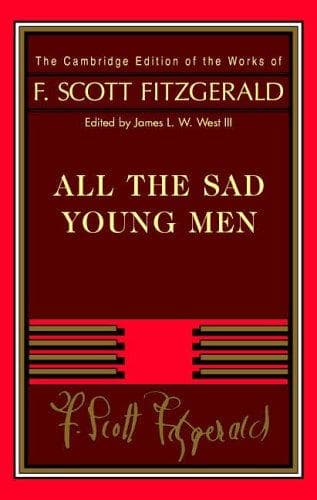
All the Sad Young MenFitzgerald, F. Scott (Francis Scott)
General
All the Sad Young Men
Fitzgerald, F. Scott (Francis Scott)
American fiction -- 20th century; Short stories, American
He was at home in New York--there was his own house with "the kind of
servants you can't get any more"--and his own family, of which, because
of his good humor and a certain ability to make things go, he was
rapidly becoming the centre, and the débutante parties, and the correct
manly world of the men's clubs, and the occasional wild spree with the
gallant girls whom New Haven only knew from the fifth row. His
aspirations were conventional enough--they included even the
irreproachable shadow he would some day marry, but they differed from
the aspirations of the majority of young men in that there was no mist
over them, none of that quality which is variously known as "idealism"
or "illusion." Anson accepted without reservation the world of high
finance and high extravagance, of divorce and dissipation, of snobbery
and of privilege. Most of our lives end as a compromise--it was as a
compromise that his life began.
He and I first met in the late summer of 1917 when he was just out of
Yale, and, like the rest of us, was swept up into the systematized
hysteria of the war. In the blue-green uniform of the naval aviation he
came down to Pensacola, where the hotel orchestras played "I'm sorry,
dear," and we young officers danced with the girls. Every one liked him,
and though he ran with the drinkers and wasn't an especially good pilot,
even the instructors treated him with a certain respect. He was always
having long talks with them in his confident, logical voice--talks which
ended by his getting himself, or, more frequently, another officer, out
of some impending trouble. He was convivial, bawdy, robustly avid for
pleasure, and we were all surprised when he fell in love with a
conservative and rather proper girl.
Her name was Paula Legendre, a dark, serious beauty from somewhere in
California. Her family kept a winter residence just outside of town, and
in spite of her primness she was enormously popular; there is a large
class of men whose egotism can't endure humor in a woman. But Anson
wasn't that sort, and I couldn't understand the attraction of her
"sincerity"--that was the thing to say about her--for his keen and
somewhat sardonic mind.
Public-domain text, read in full here on John Shaqi.
Reviews
Reviews
No reviews yet
Be the first to share your thoughts on this work.
Join the Discussion
Join the discussion
Sign in to leave a comment or review.
Sign InorCreate an account