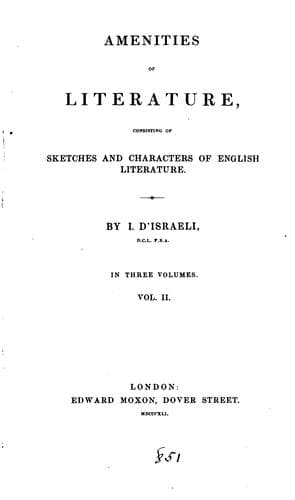
Amenities of Literature: Consisting of Sketches and Characters of English LiteratureDisraeli, Isaac
History
Amenities of Literature: Consisting of Sketches and Characters of English Literature
Disraeli, Isaac
Authors, English -- Biography; English literature -- History and criticism; Great Britain -- Intellectual life
[11] The origin of Stonehenge is as unknown as that of the Pyramids.
As it is evident that those huge masses could not have been raised
and fixed without the machinery of art, Mr. Owen, the Welsh
antiquary, infers, that this building, if such it may be called,
could not have been erected till that later period when the Druidical
genius declined and submitted to Christianity, and the Druids were
taught more skilful masonry in stone, though without mortar. It has
been, however, considered, that those masses which have been ascribed
to the necromancer Merlin, or the more ancient giants, might have
been the work of the Britons themselves, who, without our knowledge
of the mechanical powers in transporting or raising ponderous bodies,
it is alleged, were men of mighty force and stature, whose
co-operation might have done what would be difficult even to our
mechanical science. The lances, helmets, and swords of these Britons
show the vast size and strength of those who wore them. The native
Americans, as those in Peru, unaided by the engines we apply to those
purposes, have raised up such vast stones in building their temples
as the architect of the present time would not perhaps hazard the
attempt to remove. "Essays by a Society at Exeter," 114.
BRITAIN AND THE BRITONS.
Britain stood as the boundary of the universe, beyond Which all was air
and water--and long it was ere the trembling coasters were certain
whether Britain was an island or a continent, a secret probably to the
dispersed natives themselves. It was the triumphant fleet of Agricola,
nearly a century after the descent of Cæsar, which, encircling it,
proclaimed to the universe that Britain was an island. From that day
Albion has lifted its white head embraced by the restless ocean, but
often betrayed by that treacherous guardian, she became the possession
of successive races.
Nations have derived their names from some accidental circumstance; some
peculiarity marking their national character, or descriptive of the site
of their country. The names of our island and of our islanders have
exercised the inquiries, and too often the ingenuity, of our antiquarian
etymologists. There are about half a hundred origins of the name of
Britain; some absurd, many fanciful, all uncertain.[1] Our primitive
ancestors distinguished themselves, in pride or simplicity, as _Brith_
and _Brithon_; _Brith_ signified stained, and _Brithon_, a stained man,
according to Camden.[2] The predilection for colouring their bodies
induced the civilized Romans to designate the people who were driven to
the Caledonian forests as _Picts_, or a painted people.
Public-domain text, read in full here on John Shaqi.
Reviews
Reviews
No reviews yet
Be the first to share your thoughts on this work.
Join the Discussion
Join the discussion
Sign in to leave a comment or review.
Sign InorCreate an account