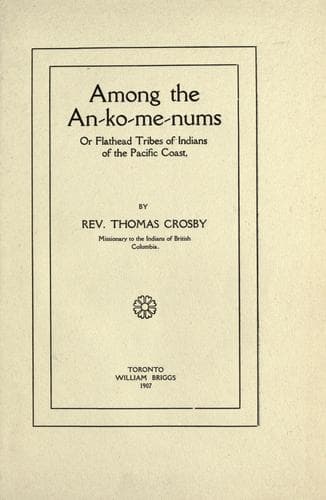
Among the An-ko-me-nums, or Flathead Tribes of Indians of the Pacific CoastCrosby, Thomas
History
Among the An-ko-me-nums, or Flathead Tribes of Indians of the Pacific Coast
Crosby, Thomas
Indians of North America -- Missions; Salish Indians
The Chinook jargon, or Oregon trade language, as it is sometimes
called, is really not a language, but is a composite of several
languages.
The first trading posts on the Coast were at Nootka, on the west coast
of Vancouver Island, and among the Chinook Indians on the Columbia
River. Among the first traders were the servants of the great fur
companies, the Hudson’s Bay, the Nor’West, and the Astor.
To the At words, learned by the traders at Nootka, were added many
others from the language of the Chinooks, as well as English and
French, the languages of the traders themselves. Some few words were
taken from the An-ko-me-num and some were formed from the sound. The
Chinook words predominating gave the name to the jargon.
It was in use as early as 1804, and in 1863 a dictionary of the jargon
was published by the Smithsonian Institute, containing some 500 words.
Of these 221 were Chinook, 18 At or Nootka, 94 French, 67 English, and
21 were credited to various branches of the Salish or Flathead family
of Indians.
In early years a trading knowledge of Chinook was necessary in order
to do business, as is a like knowledge of French on the borders of
the Province of Quebec. It is now rapidly falling into disuse, the
result of the training in English which some of the later generations
have received in the school. At the best it is but a wretched means of
communication, poor in expression and almost destitute of grammatical
forms.
“Klah-how-yah,” the term of salutation, bears such a striking
resemblance to “How are you?” that one is disposed to accept its
derivation from the oft-repeated enquiries of the friends of the
intrepid explorer Clark after his health, “Clak-how-yah?”
“Tum-tum” is a sound word for heart, and is used as well to express
will, purpose, desire. “Lip-lip” (to boil) is another such word,
imitating boiling water. “Hee-hee” indicates laughter, hence any kind
of amusement. “Kol-sick-waum-sick” is very expressive of fever and
ague.
“Mamook” (to make) can be used with any noun to indicate some form of
activity.
“Illa-hee” (ground) is linked with different words to convey a more
extended idea. “Saghalie illahee” means literally “highlands,” but also
suggests “a mountain,” and finally “heaven.” “Boston illahee,” the
United States, etc.
“Saghalie tyee,” which literally means “the chief above,” is the word
used for God.
The poverty of expression may be gathered from the fact that “tikke,”
meaning “to wish, to desire,” is the only way to express the cardinal
virtue “love.” “Happiness,” “joy,” as well as “good health,” are simply
“klosh tumtum,” which literally means a “good heart.”
“Skookum tumtum” (a strong heart) conveys the idea of “courage.”
“Chako” (come) and “chee” (new) are combined in an expression with
which most Westerners are familiar, “chee-chako” (newcomer) or
“tenderfoot.”
Public-domain text, read in full here on John Shaqi.
Reviews
Reviews
No reviews yet
Be the first to share your thoughts on this work.
Join the Discussion
Join the discussion
Sign in to leave a comment or review.
Sign InorCreate an account