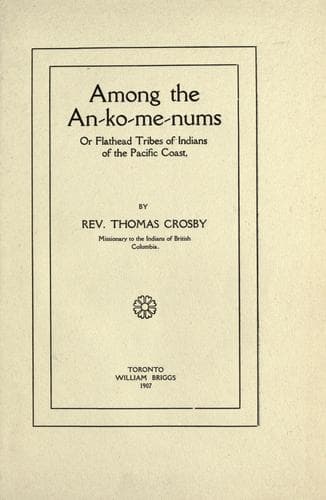
Among the An-ko-me-nums, or Flathead Tribes of Indians of the Pacific Coast — John Shaqi
Among the An-ko-me-nums, or Flathead Tribes of Indians of the Pacific CoastCrosby, Thomas
History
Among the An-ko-me-nums, or Flathead Tribes of Indians of the Pacific Coast
Crosby, Thomas
Indians of North America -- Missions; Salish Indians
An amusing story is told of a certain dignitary of the Church,
which very fully illustrates the powers and limitations of Chinook.
Addressing, among other audiences, a band of Coast Indians, he began
with the flowery and high-sounding sentence, “Children of the forest.”
The interpreter translated it into good Chinook, but the Indians
naturally enough were indignant, and only a few remained to hear him
out. “Children of the forest” literally translated was “Tenas man kopa
hyas stik,” which means simply “Little man among big stick,” and they
resented being called “little men,” or even children, and they did not
live in the woods.
NO CHINOOK FOR ME.
From the first I refused to have anything to do with Chinook, and when
the people would meet me on the road and commence to talk in it, I
made them understand by signs that I wished them to speak their own
language, in order that I might learn it.
So intense was my anxiety to get their language that I found myself,
when asleep, dreaming in it, and dreaming that I was preaching to
hundreds of people in their own tongue.
I attended the great feasts and heathen councils, and sat by the hour
listening to the old chiefs and orators relating the stories of the
chase, or recounting the tales of the bloody deeds of other days, when
they went out on great war expeditions and returned with many scalps.
How the old orators would rise with the enthusiasm of the occasion and
seem to make the ground tremble under their feet as they rejoicingly
told of the names and deeds of their fathers, to fire the ambitions of
the young princes and young men of rank--for it was only the high-caste
who were permitted to sit in these councils. It was at these gatherings
we got the proper sound of many words.
The children also were a great help to me in the study of the language.
As I gave them the English name for the objects around them I would
have them repeat it in their own tongue, and by earnest perseverance
and the help of God I soon had the unspeakable joy of being able to
preach to them in their own language the unsearchable riches of Christ.
In all my work since then I have experienced that in no way can one
properly preach the truth to a people except in their own language.
This knowledge of the language opened up my way to other tribes and
bands of the same nationality.
On my first visit to the Fraser River, some years later, I came to
a village early one morning, and, stepping out of my canoe, shouted
out at the top of my voice in An-ko-me-num, “Why are all the chiefs
sleeping like children so late this morning?” The old men rushed out to
see the big Indian. I again shouted out the same words, and they cried
out, “Listen to him! Where has he come from? We heard no white man
speak like this. Has he come from above?”
Public-domain text, read in full here on John Shaqi.
Reviews
Reviews
No reviews yet
Be the first to share your thoughts on this work.
Join the Discussion
Join the discussion
Sign in to leave a comment or review.
Sign InorCreate an account