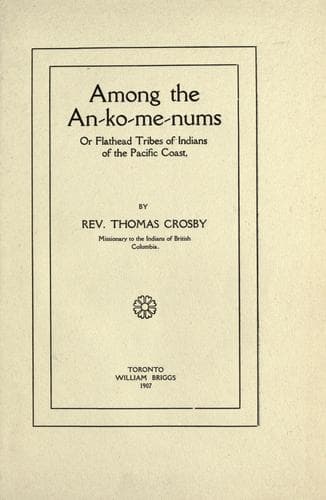
Among the An-ko-me-nums, or Flathead Tribes of Indians of the Pacific Coast — John Shaqi
Among the An-ko-me-nums, or Flathead Tribes of Indians of the Pacific CoastCrosby, Thomas
History
Among the An-ko-me-nums, or Flathead Tribes of Indians of the Pacific Coast
Crosby, Thomas
Indians of North America -- Missions; Salish Indians
On one of my canoe trips years ago around Burrard Inlet, when there was
only one sawmill where now a beautiful city (Vancouver) and a number of
thriving villages are situated, a white man, who had made me welcome
to his home and treated me to dinner, said, as I was getting into my
canoe, while a number of white men stood by, “Do you know what I was
thinking, Mr. Crosby? That if you would put a blanket on and get into
the canoe and commence to talk, nobody would know you from an Indian.”
I said, “I beg your pardon, sir; I didn’t know that I looked so much
like an Indian.”
“Oh!” he replied, “I didn’t mean that; I meant to say, you speak the
language so well that we could not tell you from an Indian speaking.”
AMUSING MISTAKES.
There are amusing sides to this matter of acquiring a language. In my
early efforts in the use of the native tongue, while I was preaching
one Sunday on the riches that are in Christ, and the poverty and misery
which sin brings, I noticed when I spoke of poverty that a group of
young men on one side could not contain themselves for laughter. They
tried to straighten up, for they were usually very respectful in the
services.
After repeating the word again and seeing the same behaviour, I
concluded I must have made some mistake, and turning to the young men
I said, “Now, young men, I see by your actions that I said something
which has caused you amusement; perhaps some word of yours which I do
not know very well. Tell me what it is.”
They hung their heads with shame. But I pressed them for reply,
saying: “If you were endeavoring to speak English you would wish to be
corrected if you had made a mistake.”
So pressed, young Quin-nom, one of their number, said: “Yes, Mr.
Crosby, you speak our language very well, almost as well as an Indian,
but to-day you made a mistake. Our word for poor is ‘sel-la-wa,’ and
when you were speaking of sin making us poor you said ‘sel-la-we-a,’
which is a woman’s name who lives away down the Coast about sixty
miles, and so we could not help laughing.”
Thus our readers may see some of the difficulties we labored under,
when only a slight change in the tone of voice might change the meaning
of a whole sentence--difficulties, however, that every student of a new
and unwritten language has to contend with.
NO SWEARING IN INDIAN.
Speaking of the peculiarities of the language, it may be remarked
that the Indian languages have no words properly to express abstract
qualities, no words to express the ideas of love, peace, pardon,
repentance, etc., as we understand them. So that one of our first tasks
was to explain to them as best we could by illustration and otherwise
the meaning of such words.
Public-domain text, read in full here on John Shaqi.
Reviews
Reviews
No reviews yet
Be the first to share your thoughts on this work.
Join the Discussion
Join the discussion
Sign in to leave a comment or review.
Sign InorCreate an account