An essay on the foundations of geometry — John Shaqi
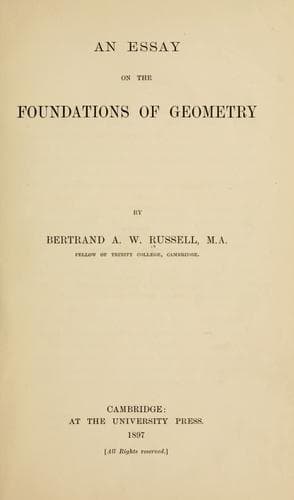
An essay on the foundations of geometryRussell, Bertrand
Philosophy
An essay on the foundations of geometry
Russell, Bertrand
Geometry -- Foundations
=8.= These two grounds of necessity, in ultimate analysis, fall
together. The _methods_ of investigation in the two cases differ
widely, but the _results_ cannot differ. For in the first case, by
analysis of the science, we discover the postulate on which alone
its reasonings are possible. Now if reasoning in the science is
impossible without some postulate, this postulate must be essential
to experience of the subject-matter of the science, and thus we
get the second ground. Nevertheless, the two methods are useful as
supplementing one another, and the first, as starting from the actual
science, is the safest and easiest method of investigation, though
the second seems the more convincing for exposition.
=9.= The course of my argument, therefore, will be as follows: In
the first chapter, as a preliminary to the logical analysis of
Geometry, I shall give a brief history of the rise and development
of non-Euclidean systems. The second chapter will prepare the ground
for a constructive theory of Geometry, by a criticism of some
previous philosophical views; in this chapter, I shall endeavour
to exhibit such views as partly true, partly false, and so to
establish, by preliminary polemics, the truth of such parts of my own
theory as are to be found in former writers. A large part of this
theory, however, cannot be so introduced, since the whole field of
projective Geometry, so far as I am aware, has been hitherto unknown
to philosophers. Passing, in the third chapter, from criticism to
construction, I shall deal first with projective Geometry. This, I
shall maintain, is necessarily true of any form of externality, and
is, since some such form is necessary to experience, completely _à
priori_. In metrical Geometry, however, which I shall next consider,
the axioms will fall into two classes: (1) Those common to Euclidean
and non-Euclidean spaces. These will be found, on the one hand,
essential to the possibility of measurement in any continuum, and
on the other hand, necessary properties of any form of externality
with more than one dimension. They will, therefore, be declared
_à priori_. (2) Those axioms which distinguish Euclidean from
non-Euclidean spaces. These will be regarded as wholly empirical.
The axiom that the number of dimensions is three, however, though
empirical, will be declared, since small errors are here impossible,
exactly and certainly true of our actual world; while the two
remaining axioms, which determine the value of the space-constant,
will be regarded as only approximately known, and certain only
within the errors of observation[4]. The fourth chapter, finally,
will endeavour to prove, what was assumed in Chapter III., that some
form of externality is necessary to experience, and will conclude by
exhibiting the logical impossibility, if knowledge of such a form is
to be freed from contradictions, of wholly abstracting this knowledge
from all reference to the matter contained in the form.
Public-domain text, read in full here on John Shaqi.
Reviews
Reviews
No reviews yet
Be the first to share your thoughts on this work.
Join the Discussion
Join the discussion
Sign in to leave a comment or review.
Sign InorCreate an account