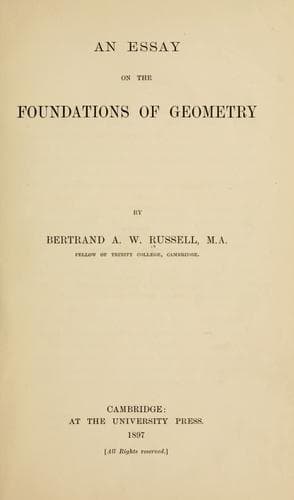
An essay on the foundations of geometryRussell, Bertrand
Philosophy
An essay on the foundations of geometry
Russell, Bertrand
Geometry -- Foundations
I shall hope to have touched, with this discussion, on all the main
points relating to the Foundations of Geometry.
FOOTNOTES:
[1] Cf. Erdmann, Axiome der Geometrie, p. 111: "Für Kant sind
Apriorität und ausschliessliche Subjectivität allerdings
Wechselbegriffe."
[2] I use "experience" here in the widest possible sense, the sense
in which the word is used by Bradley.
[3] Where the branch of experience in question is essential to all
experience, the resulting apriority may be regarded as absolute;
where it is necessary only to some special science, as relative to
that science.
[4] I have given no account of these empirical proofs, as they seem
to be constituted by the whole body of physical science. Everything
in physical science, from the law of gravitation to the building of
bridges, from the spectroscope to the art of navigation, would be
profoundly modified by any considerable inaccuracy in the hypothesis
that our actual space is Euclidean. The observed truth of physical
science, therefore, constitutes overwhelming empirical evidence that
this hypothesis is very approximately correct, even if not rigidly
true.
CHAPTER I.
A SHORT HISTORY OF METAGEOMETRY.
=10.= When a long established system is attacked, it usually happens
that the attack begins only at a single point, where the weakness of
the established doctrine is peculiarly evident. But criticism, when
once invited, is apt to extend much further than the most daring, at
first, would have wished.
"First cut the liquefaction, what comes last,
But Fichte's clever cut at God himself?"
So it has been with Geometry. The liquefaction of Euclidean orthodoxy
is the axiom of parallels, and it was by the refusal to admit this
axiom without proof that Metageometry began. The first effort in
this direction, that of Legendre[5], was inspired by the hope of
deducing this axiom from the others--a hope which, as we now know,
was doomed to inevitable failure. Parallels are defined by Legendre
as lines in the same plane, such that, if a third line cut them, it
makes the sum of the interior and opposite angles equal to two right
angles. He proves without difficulty that such lines would not meet,
but is unable to prove that non-parallel lines in a plane must meet.
Similarly he can prove that the sum of the angles of a triangle
cannot exceed two right angles, and that if any one triangle has a
sum equal to two right angles, all triangles have the same sum; but
he is unable to prove the existence of this one triangle.
Public-domain text, read in full here on John Shaqi.
Reviews
Reviews
No reviews yet
Be the first to share your thoughts on this work.
Join the Discussion
Join the discussion
Sign in to leave a comment or review.
Sign InorCreate an account