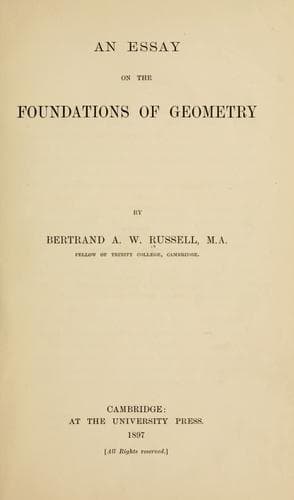
An essay on the foundations of geometryRussell, Bertrand
Philosophy
An essay on the foundations of geometry
Russell, Bertrand
Geometry -- Foundations
_Cayley_ was, to the last, a staunch supporter of Euclidean
_space_, though he believed that non-Euclidean _Geometries_ could
be applied, within Euclidean space, by a change in the definition
of distance[39]. He has thus, in spite of his Euclidean orthodoxy,
provided the believers in the possibility of non-Euclidean spaces
with one of their most powerful weapons. In his "Sixth Memoir upon
Quantics" (1859), he set himself the task of "establishing the notion
of distance upon purely descriptive principles." He showed that, with
the ordinary notion of distance, it can be rendered projective by
reference to the circular points and the line at infinity, and that
the same is true of angles[40]. Not content with this, he suggested
a new definition of distance, as the inverse sine or cosine of a
certain function of the coordinates; with this definition, the
properties usually known as metrical become projective properties,
having reference to a certain conic, called by Cayley the Absolute.
(The circular points are, analytically, a degenerate conic, so that
ordinary Geometry forms a particular case of the above.) He proves
that, when the Absolute is an _imaginary_ conic, the Geometry so
obtained for two dimensions is spherical Geometry. The correspondence
with Lobatchewsky, in the case where the Absolute is _real_, is not
worked out: indeed there is, throughout, no evidence of acquaintance
with non-Euclidean systems. The importance of the memoir, to Cayley,
lies entirely in its proof that metrical is only a branch of
descriptive Geometry.
=32.= The connection of Cayley's Theory of Distance with Metageometry
was first pointed out by Klein[41]. Klein showed in detail that, if
the Absolute be real, we get Lobatchewsky's (hyperbolic) system; if
it be imaginary, we get either spherical Geometry or a new system,
analogous to that of Helmholtz, called by Klein elliptic; if the
Absolute be an imaginary point-pair, we get parabolic Geometry, and
if, in particular, the point-pair be the circular points, we get
ordinary Euclid. In elliptic Geometry, two straight lines in the same
plane meet in only one point, not two as in Helmholtz's system. The
distinction between the two kinds of Geometry is difficult, and will
be discussed later.
Public-domain text, read in full here on John Shaqi.
Reviews
Reviews
No reviews yet
Be the first to share your thoughts on this work.
Join the Discussion
Join the discussion
Sign in to leave a comment or review.
Sign InorCreate an account