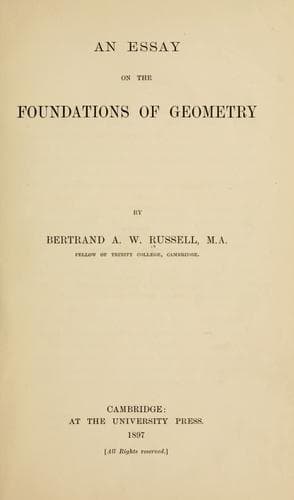
An essay on the foundations of geometryRussell, Bertrand
Philosophy
An essay on the foundations of geometry
Russell, Bertrand
Geometry -- Foundations
and are inclined to deny that _two_ points have a unique relation at
all. This confusion, in projective Geometry, shows the importance of
a name, and should make us chary of allowing new meanings to obscure
one of the fundamental properties of space.
=38.= It remains to discuss the manner in which non-Euclidean
Geometries result from the projective definition of distance, as also
the true interpretation to be given to this view of Metageometry. It
is to be observed that the projective methods which follow Cayley
deal throughout with a Euclidean plane, on which they introduce
different measures of distance. Hence arises, in any interpretation
of these methods, an apparent subordination of the non-Euclidean
spaces, as though these were less self-subsistent than Euclid's.
This subordination is not intended in what follows; on the contrary,
the correlation with Euclidean space is regarded as valuable,
first, because Euclidean space has been longer studied and is more
familiar, but secondly, because this correlation proves, when truly
interpreted, that the other spaces are self-subsistent. We may
confine ourselves chiefly, in discussing this interpretation, to
distances measured along a single straight line. But we must be
careful to remember that the metrical definition of distance--which,
according to the view here advocated, is the only adequate
definition--is the same in Euclidean and in non-Euclidean spaces; to
argue in its favour is not, therefore, to argue in favour of Euclid.
Public-domain text, read in full here on John Shaqi.
Reviews
Reviews
No reviews yet
Be the first to share your thoughts on this work.
Join the Discussion
Join the discussion
Sign in to leave a comment or review.
Sign InorCreate an account