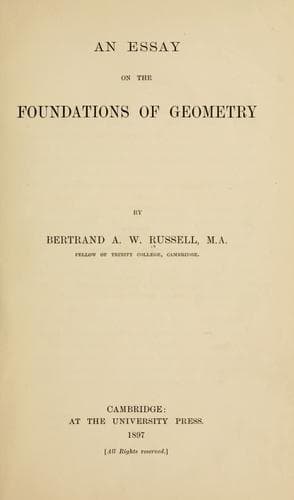
An essay on the foundations of geometryRussell, Bertrand
Philosophy
An essay on the foundations of geometry
Russell, Bertrand
Geometry -- Foundations
Now, in Geometry, the result of two successive motions or
collineations of a figure can always be obtained by a single motion
or collineation, and any motion or collineation can be built up
of a series of infinitesimal motions or collineations. Moreover
the analytical expression of either is a certain transformation
of the coordinates of all the points of the figure[61]. Hence the
transformations determining a motion or a collineation are such
as to form a continuous group. But the question of the projective
equivalence of two figures, to which all projective Geometry is
reducible, must always be dealt with by a collineation; and the
question of the equality of two figures, to which all metrical
Geometry is reducible, must always be decided by a motion such as
to cause superposition; hence the whole subject of Geometry may
be regarded as a theory of the continuous groups which define all
possible collineations and motions.
Now Sophus Lie has developed, at great length, the purely analytical
theory of groups; he has therefore, by this method of formulating
the problem, a very powerful weapon ready for the attack. In two
papers "On the foundations of Geometry[62]," undertaken at Klein's
urgent request, he takes premisses which roughly correspond to those
of Helmholtz, omitting Monodromy, and applies the theory of groups to
the deduction of their consequences[63]. Helmholtz's work, he says,
can hardly be looked upon as _proving_ its conclusions, and indeed
the more searching analysis of the group-theory reveals several
possibilities unknown to Helmholtz. Nevertheless, as a pioneer,
devoid of Lie's machinery, Helmholtz deserves, I think, more praise
than Lie is willing to give him[64].
Lie's method is perfectly exhaustive; omitting the premiss of
Monodromy, the others show that a body has six degrees of freedom,
_i.e._ that the group giving all possible motions of a body will
have six independent members; if we keep one point fixed, the
number of independent members is reduced to three. He then, from
his general theory, enumerates all the groups which satisfy this
condition. In order that such a group should give possible motions,
it is necessary, by Helmholtz's second axiom, that it should leave
invariant some function of the coordinates of any two points. This
eliminates several of the groups previously enumerated, each of which
he discusses in turn. He is thus led to the following results:
I. _In two dimensions_, if free mobility is to hold _universally_,
there are no groups satisfying Helmholtz's first three axioms, except
those which give the ordinary Euclidean and non-Euclidean motions;
but if it is to hold only _within a certain region_, there is also
a possible group in which the curve described by any point in a
rotation is not closed, but an equiangular spiral. To exclude this
possibility, Helmholtz's axiom of Monodromy is required.
Public-domain text, read in full here on John Shaqi.
Reviews
Reviews
No reviews yet
Be the first to share your thoughts on this work.
Join the Discussion
Join the discussion
Sign in to leave a comment or review.
Sign InorCreate an account