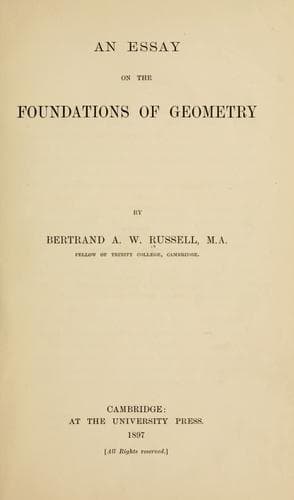
An essay on the foundations of geometryRussell, Bertrand
Philosophy
An essay on the foundations of geometry
Russell, Bertrand
Geometry -- Foundations
II. _In three dimensions_, the results go still more against
Helmholtz. Assuming free mobility only _within a certain region_, we
have to distinguish two cases: _Either_ free mobility holds, within
that region, absolutely without exception, _i.e._ when one point is
held fast, _every_ other point within the region can move freely
over a surface: in this case the axiom of Monodromy is unnecessary,
and the first three axioms suffice to define our group as that of
Euclidean and non-Euclidean motions. _Or_ free mobility, within the
specified region, holds only of every point _of general position_,
while the points of a certain line, when one point is fixed, are only
able to move on that line, not on a surface: when this is the case,
other groups are possible, and can only be excluded by Helmholtz's
fourth axiom.
Having now stated the purely mathematical results of Lie's
investigations, we may return to philosophical considerations, by
which Helmholtz's work was mainly motived. It becomes obvious,
not only that exceptions within a certain region, but also that
limitation to a certain region, of the axiom of Free Mobility,
are philosophically quite impossible and inconceivable. How can a
certain line, or a certain surface, form an impassable barrier in
space, or have any mobility different in kind from that of all other
lines or surfaces? The notion cannot, in philosophy, be permitted
for a moment, since it destroys that most fundamental of all the
axioms, the homogeneity of space. We not only may, therefore, but
must take Helmholtz's axiom of Free Mobility in its very strictest
sense; the axiom of Monodromy thus becomes mathematically, as well
as philosophically, superfluous. This is, from a philosophical
standpoint, the most important of Lie's results.
Public-domain text, read in full here on John Shaqi.
Reviews
Reviews
No reviews yet
Be the first to share your thoughts on this work.
Join the Discussion
Join the discussion
Sign in to leave a comment or review.
Sign InorCreate an account