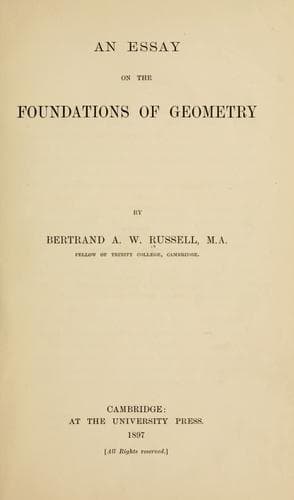
An essay on the foundations of geometryRussell, Bertrand
Philosophy
An essay on the foundations of geometry
Russell, Bertrand
Geometry -- Foundations
=46.= I have now come to the end of my history of Metageometry.
It has not been my aim to give an exhaustive account of even the
important works on the subject--in the third period, especially, the
names of Poincaré, Pasch, Cremona, Veronese, and others who might be
mentioned, would have cried shame upon me, had I had any such object.
But I have tried to set forth, as clearly as I could, the principles
at work in the various periods, the motives and results of successive
theories. We have seen how the philosophical motive, at first
predominant, has been gradually extruded by the purely mathematical
and technical spirit of most recent Geometers. At first, to discredit
the Transcendental Aesthetic seemed, to Metageometers, as important
as to advance their science; but from the works of Cayley, Klein
or Lie, no reader could gather that Kant had ever lived. We have
also seen, however, that as the interest _in_ philosophy waned, the
interest _for_ philosophy increased: as the mathematical results
shook themselves free from philosophical controversies, they
assumed gradually a stable form, from which further development,
we may reasonably hope, will take the form of growth, rather than
transformation. The same gradual development out of philosophy might,
I believe, be traced in the infancy of most branches of mathematics;
when philosophical motives cease to operate, this is, in general, a
sign that the stage of uncertainty as to premisses is past, so that
the future belongs entirely to mathematical technique. When this
stable stage has been attained, it is time for Philosophy to borrow
of Science, accepting its final premisses as those imposed by a real
necessity of fact or logic.
=47.= Now in discussing the systems of Metageometry, we have found
two kinds, radically distinct and subject to different axioms. The
historically prior kind, which deals with metrical ideas, discusses,
to begin with, the conditions of Free Mobility, which is essential to
all measurement of space. It finds the analytical expression of these
conditions in the existence of a space-constant, or constant measure
of curvature, which is equivalent to the homogeneity of space. This
is its first axiom.
Its second axiom states that space has a finite integral number of
dimensions, _i.e._ in metrical terms, that the position of a point,
relative to any other figure in space, is uniquely determined by a
finite number of spatial magnitudes, called coordinates.
The third axiom of metrical Geometry may be called, to distinguish it
from the corresponding projective axiom, the axiom of distance. There
exists one relation, it says, between any two points, which can be
preserved unaltered in a combined motion of both points, and which,
in any motion of a system as one rigid body, is always unaltered.
This relation we call distance.
Public-domain text, read in full here on John Shaqi.
Reviews
Reviews
No reviews yet
Be the first to share your thoughts on this work.
Join the Discussion
Join the discussion
Sign in to leave a comment or review.
Sign InorCreate an account