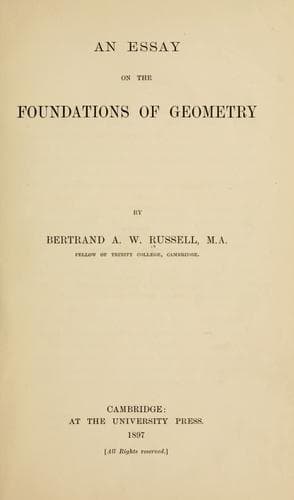
An essay on the foundations of geometryRussell, Bertrand
Philosophy
An essay on the foundations of geometry
Russell, Bertrand
Geometry -- Foundations
136. Since its elements would be immovably fixed in a series 142
137. Two positions have a relation independent of other
positions, 143
138. Since positions are wholly defined by mutually independent
relations 143
139. Hence projective Geometry is wholly _à priori_, 146
140. Though metrical Geometry contains an empirical element 146
SECTION B. THE AXIOMS OF METRICAL GEOMETRY.
141. Metrical Geometry is distinct from projective, but has the
same fundamental postulate 147
142. It introduces the new idea of motion, and has three
_à priori_ axioms 148
I. _The Axiom of Free Mobility._
143. Measurement requires a criterion of spatial equality 149
144. Which is given by superposition, and involves the axiom
of Free Mobility 150
145. The denial of this axiom involves an action of empty
space on things 151
146. There is a mathematically possible alternative to the axiom, 152
147. Which, however, is logically and philosophically untenable 153
148. Though Free Mobility is _à priori_, actual measurement is
empirical 154
149. Some objections remain to be answered, concerning-- 154
150. (1) The comparison of volumes and of Kant's symmetrical
objects 154
151. (2) The measurement of time, where congruence is impossible 156
152. (3) The immediate perception of spatial magnitude; and 157
153. (4) The Geometry of non-congruent surfaces 158
154. Free Mobility includes Helmholtz's Monodromy 159
155. Free Mobility involves the relativity of space 159
156. From which, reciprocally, it can be deduced 160
157. Our axiom is therefore _à priori_ in a double sense 160
II. _The Axiom of Dimensions._
158. Space must have a finite integral number of dimensions 161
159. But the restriction to three is empirical 162
160. The general axiom follows from the relativity of position 162
161. The limitation to three dimensions, unlike most empirical
knowledge, is accurate and certain 163
III. _The Axiom of Distance._
162. The axiom of distance corresponds, here, to that of the
straight line in projective Geometry 164
163. The possibility of spatial measurement involves a magnitude
uniquely determined by two points, 164
Public-domain text, read in full here on John Shaqi.
Reviews
Reviews
No reviews yet
Be the first to share your thoughts on this work.
Join the Discussion
Join the discussion
Sign in to leave a comment or review.
Sign InorCreate an account