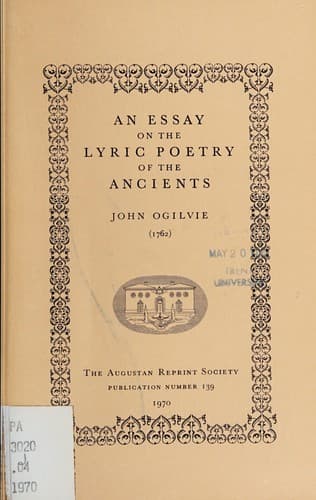
An Essay on the Lyric Poetry of the Ancients — John Shaqi
An Essay on the Lyric Poetry of the AncientsOgilvie, John
History
An Essay on the Lyric Poetry of the Ancients
Ogilvie, John
Classical poetry -- History and criticism
When your Lordship reflects on the Nature and End of Lyric Poetry,
it will appear to be at least as much characterised by the Graces of
ornament as any other species whatever. We have already seen that the
Ode was early consecrated to the purposes of Religion, and that it was
intended to raise Admiration by extolling the attributes of the Supreme
Being. On a subject of this nature the Poet probably thought, that
sublime and exuberant imagery was necessary to support the grandeur of
those sentiments which were naturally suggested to his mind[58]. Even
when these original topics were laid aside, and the Lyric Muse acted in
another sphere, her strains were still employed, either to commemorate
the actions of Deified Heroes, or to record the exploits of persons whom
rank and abilities rendered eminently conspicuous.
[Footnote 58: For this reason, says an ingenious and learned
Critic, L’Ode monte dans les Cieux, pour y empronter ses images et
ses comparaisons du tonnerre, des astres, et des Dieux memes, &c.
Reflex. Crit. Vol. I. Sect. 33.]
All these subjects afford a noble field for the play of imagination, and
it is a certain truth that the purity of composition is generally
defective, in proportion to that degree of sublimity at which the Poet
is capable of arriving[59]. Great objects are apt to confound and dazzle
the imagination. In proportion as this faculty expands to take them in,
its power of conceiving them distinctly becomes less adequate to the
subject; and when the mind is overwrought and drained as it were of
sentiment, it is no wonder that we find it sometimes attempting to
repair this loss, by substituting in the room of true sublimity an
affected pomp and exuberance of expression.
[Footnote 59: Εγω δε οιδα μεν ὡς αἱ ὑπερβολαι μεγεθους φυσαι
ἡκιστα καθαραι. Το γαρ εν παντα ακριβες, κινδυνος σμικροτητος‧ εν
δε τοις μεγεθεσιν ὡσπερ εν τοις αγαν πλουτοις, ειναι τε χρη και
παραλιγωρουμενον. Μη ποτε ηδε τουτο και αναγκαιουσιν, το τας μεν
τα{πειν}ας και μεσας φυσεις δια το μηδαμη παρακινδυνευειν μηδε
εφιεσθαι των ακρων, αδαμαρτητου ὡς επι το πολυ και ασφαλεστερας
διαφερειν. Longin. de Sublim. Sect. 33.]
That we may conceive more fully the propriety of this observation with
regard to Lyric Poetry, I shall now proceed to enquire what part
Imagination naturally claims in the composition of the Ode, and what are
the errors into which the Poet is most ready to be betrayed.
Public-domain text, read in full here on John Shaqi.
Reviews
Reviews
No reviews yet
Be the first to share your thoughts on this work.
Join the Discussion
Join the discussion
Sign in to leave a comment or review.
Sign InorCreate an account