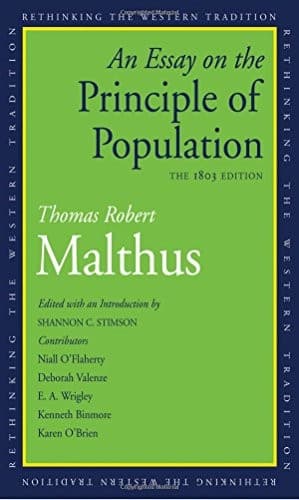
An Essay on the Principle of Population — John Shaqi
An Essay on the Principle of PopulationMalthus, T. R. (Thomas Robert)
Philosophy
An Essay on the Principle of Population
Malthus, T. R. (Thomas Robert)
Population
The second, or positive check to population examined, in England--The
true cause why the immense sum collected in England for the poor does
not better their condition--The powerful tendency of the poor laws to
defeat their own purpose--Palliative of the distresses of the poor
proposed--The absolute impossibility, from the fixed laws of our
nature, that the pressure of want can ever be completely removed from
the lower classes of society--All the checks to population may be
resolved into misery or vice.
The positive check to population, by which I mean the check that
represses an increase which is already begun, is confined chiefly,
though not perhaps solely, to the lowest orders of society.
This check is not so obvious to common view as the other I have
mentioned, and, to prove distinctly the force and extent of its
operation would require, perhaps, more data than we are in possession
of. But I believe it has been very generally remarked by those who have
attended to bills of mortality that of the number of children who die
annually, much too great a proportion belongs to those who may be
supposed unable to give their offspring proper food and attention,
exposed as they are occasionally to severe distress and confined,
perhaps, to unwholesome habitations and hard labour. This mortality
among the children of the poor has been constantly taken notice of in
all towns. It certainly does not prevail in an equal degree in the
country, but the subject has not hitherto received sufficient attention
to enable anyone to say that there are not more deaths in proportion
among the children of the poor, even in the country, than among those
of the middling and higher classes. Indeed, it seems difficult to
suppose that a labourer's wife who has six children, and who is
sometimes in absolute want of bread, should be able always to give them
the food and attention necessary to support life. The sons and
daughters of peasants will not be found such rosy cherubs in real life
as they are described to be in romances. It cannot fail to be remarked
by those who live much in the country that the sons of labourers are
very apt to be stunted in their growth, and are a long while arriving
at maturity. Boys that you would guess to be fourteen or fifteen are,
upon inquiry, frequently found to be eighteen or nineteen. And the lads
who drive plough, which must certainly be a healthy exercise, are very
rarely seen with any appearance of calves to their legs: a circumstance
which can only be attributed to a want either of proper or of
sufficient nourishment.
Public-domain text, read in full here on John Shaqi.
Reviews
Reviews
No reviews yet
Be the first to share your thoughts on this work.
Join the Discussion
Join the discussion
Sign in to leave a comment or review.
Sign InorCreate an account