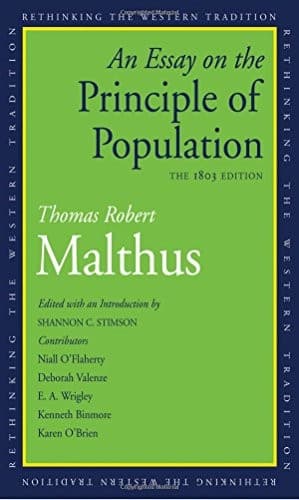
An Essay on the Principle of Population — John Shaqi
An Essay on the Principle of PopulationMalthus, T. R. (Thomas Robert)
Philosophy
An Essay on the Principle of Population
Malthus, T. R. (Thomas Robert)
Population
To remedy the frequent distresses of the common people, the poor laws
of England have been instituted; but it is to be feared, that though
they may have alleviated a little the intensity of individual
misfortune, they have spread the general evil over a much larger
surface. It is a subject often started in conversation and mentioned
always as a matter of great surprise that, notwithstanding the immense
sum that is annually collected for the poor in England, there is still
so much distress among them. Some think that the money must be
embezzled, others that the church-wardens and overseers consume the
greater part of it in dinners. All agree that somehow or other it must
be very ill-managed. In short the fact that nearly three millions are
collected annually for the poor and yet that their distresses are not
removed is the subject of continual astonishment. But a man who sees a
little below the surface of things would be very much more astonished
if the fact were otherwise than it is observed to be, or even if a
collection universally of eighteen shillings in the pound, instead of
four, were materially to alter it. I will state a case which I hope
will elucidate my meaning.
Suppose that by a subscription of the rich the eighteen pence a day
which men earn now was made up five shillings, it might be imagined,
perhaps, that they would then be able to live comfortably and have a
piece of meat every day for their dinners. But this would be a very
false conclusion. The transfer of three shillings and sixpence a day to
every labourer would not increase the quantity of meat in the country.
There is not at present enough for all to have a decent share. What
would then be the consequence? The competition among the buyers in the
market of meat would rapidly raise the price from sixpence or
sevenpence, to two or three shillings in the pound, and the commodity
would not be divided among many more than it is at present. When an
article is scarce, and cannot be distributed to all, he that can shew
the most valid patent, that is, he that offers most money, becomes the
possessor. If we can suppose the competition among the buyers of meat
to continue long enough for a greater number of cattle to be reared
annually, this could only be done at the expense of the corn, which
would be a very disadvantagous exchange, for it is well known that the
country could not then support the same population, and when
subsistence is scarce in proportion to the number of people, it is of
little consequence whether the lowest members of the society possess
eighteen pence or five shillings. They must at all events be reduced to
live upon the hardest fare and in the smallest quantity.
Public-domain text, read in full here on John Shaqi.
Reviews
Reviews
No reviews yet
Be the first to share your thoughts on this work.
Join the Discussion
Join the discussion
Sign in to leave a comment or review.
Sign InorCreate an account