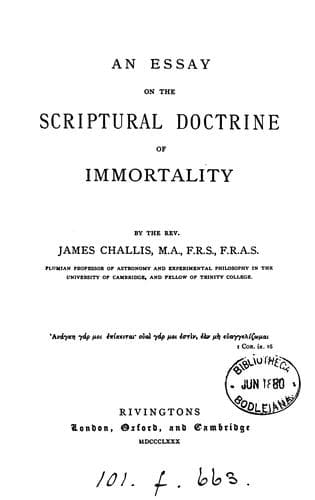
An Essay on the Scriptural Doctrine of ImmortalityChallis, James
Religion
An Essay on the Scriptural Doctrine of Immortality
Challis, James
Immortality
As there was no more occasion for signifying acceptance of the covenant
by sacrifice after the sacrifice {31} of Jesus Christ, that form of
religious worship came to an end. Thenceforth faith in the covenant
was to be expressed by means of symbols which pointed to the sacrifice
made once and for all time on the cross. The ordained symbols are
_bread_ and _wine_, taken in the Lord's Supper. The minister of the
Gospel has succeeded to the Jewish priest in respect to giving _surety_
officially for the fulfilment of the covenant, and on that account may
with propriety be called a _priest_. There is no longer an altar,
because the acceptance of the covenant is not, as in the Jewish
worship, indicated by sacrifice, but by partaking of _food_ in the
forms of bread and wine at "the _table_ of the Lord." The Christian
minister, in delivering these symbols to the worshippers, gives, in
virtue of his mediating office, sureties for the fulfilment of the
covenant of eternal life; the worshipper who partakes of them in faith
receives them as such sureties, and looks for the fulfilment of the
covenant. No doubt this office should be discharged by a good and wise
minister, who has been regularly appointed thereto; but for the
efficacy of the ordinance the chief requisite is _faith_ on the part of
the recipient--an intelligent faith such as that which has just been
mentioned.
The Sacrament of the Lord's Supper is justly regarded as the central
ordinance of the Christian religion, and, therefore, of necessity has
relation to the means whereby immortality is secured. In fact, {32} in
each of the four records of its institution given in Scripture, the
word "testament" (_diatheke_) occurs: in St. Matthew and St. Mark we
have, "This is my blood of the New Testament," and in St. Luke and 1
Cor. xi., "This cup is the New Testament in my blood." What is the
meaning of "testament" in these passages, and how is the testament
related to the "blood" of Jesus Christ? It is worthy of notice that
these questions have received no special consideration in the recent
controversies respecting the Lord's Supper, although in order to arrive
at the full signification of that ordinance it is clearly necessary to
be able to give answers to them. As far as regards the general meaning
of the testament, or covenant, its relation to our immortality, and the
surety for its fulfilment given by the blood (i.e. the death) of Jesus
Christ, enough, I think, has been said in the foregoing arguments; it
remains to inquire, for more complete understanding of the doctrine of
the Sacrament, what relations the symbols _bread_ and _wine_ have to
the _Body_ and _Blood_ of Christ.
Public-domain text, read in full here on John Shaqi.
Reviews
Reviews
No reviews yet
Be the first to share your thoughts on this work.
Join the Discussion
Join the discussion
Sign in to leave a comment or review.
Sign InorCreate an account