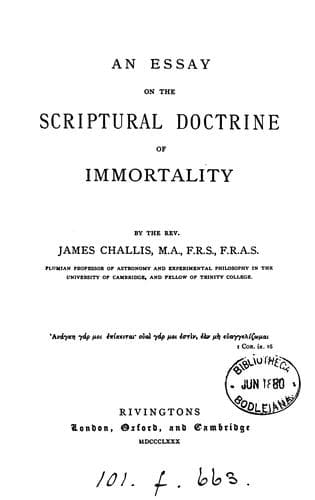
An Essay on the Scriptural Doctrine of ImmortalityChallis, James
Religion
An Essay on the Scriptural Doctrine of Immortality
Challis, James
Immortality
"Bread strengthens man's heart," and "wine makes it glad" (Ps. civ.
15). To strengthen the _heart_ is to produce confidence. Now, it may
be asserted that confidence and joy, being incorporeal entities, are
the same in essence under whatever external conditions they are
generated. They are the same whether experienced in consequence of
taking {33} bread and wine, or in consequence of understanding and
accepting the covenant of life made sure by the body and blood of
Christ. Although physical science is wholly incapable of informing us
_how_ the _corporeal_ elements bread and wine produce in those who
partake of them _feelings_ of strength and gladness (the antecedents
and consequents not being in the same category), we can yet understand
that the Creator of all things might by His immediate will attach to
those substances such effects, not alone for the sake of man's body,
but for the higher purpose of thereby informing his spirit that there
is cause for confidence and joy in the broken body of the Lord, and his
poured-out blood. This view is justified by the language of St. Paul,
where he says, speaking of the Son of God, that "all things were
created through him and _unto_ him" (_eis auton_, Col. i. 16); from
which doctrine it may be inferred that our Lord, having regard to the
cognizable effects of bread and wine spoken of by the Psalmist, said of
bread, "This is my body," and of wine, "This is my blood," because his
body and blood, when "spiritually discerned," have _the very same
effects_.
Public-domain text, read in full here on John Shaqi.
Reviews
Reviews
No reviews yet
Be the first to share your thoughts on this work.
Join the Discussion
Join the discussion
Sign in to leave a comment or review.
Sign InorCreate an account