An Essay on the Scriptural Doctrine of Immortality — John Shaqi
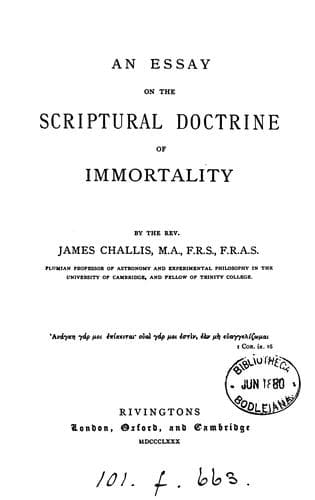
An Essay on the Scriptural Doctrine of ImmortalityChallis, James
Religion
An Essay on the Scriptural Doctrine of Immortality
Challis, James
Immortality
The sentence pronounced on the unrighteous, and the reasons for it, are
thus stated in _vv._ 41-45: "Then shall he say also to them on the left
hand, Depart from me, ye cursed, into the [oe]onian fire (_to pur to
aionion_, i.e. the fire of judgment in the future _aion_) prepared for
the devil and his angels: for I was hungry, and ye gave me no meat; I
was thirsty, and ye gave me no drink; I was a stranger, and ye took me
not in; naked, and ye clothed me not; sick, and in prison, and ye
visited me not. Then shall they also answer him, saying, Lord, when
saw we thee hungry, or athirst, or a stranger, or naked, or sick, or in
prison, and did not minister unto thee? Then shall he answer them,
saying, Verily, I say to you, inasmuch as ye did it not to one of the
least of these, ye did it not to me." It should be noticed that the
terms of this award are the exact contraries of those of the award to
the righteous. On the one hand, the King says, "Come, ye blessed of my
Father, inherit {70} the kingdom prepared for you from the foundation
of the world;" on the other, he says, "Depart from me, ye cursed, into
the [oe]onian fire prepared for the devil and his angels;" and the
account of what the Judge further says to the unrighteous, and of what
they say to him, although somewhat briefer than that relating to the
righteous, is made up of exactly opposite particulars. On this
principle, since the decision respecting the righteous is pronounced on
the grounds of positive works of righteousness done in humility and
faith, that respecting the unrighteous has regard only to the
_omission_ to do such works through presumption and unbelief. The same
exhibition of opposite circumstances and qualities, and the same
principle of condemnation for sins of omission exclusively of those of
commission, are observable in the two other symbolic representations
contained in the same chapter--the parable of the ten virgins, and the
parable of the talents. In short, the general purport of the chapter
is to indicate, that in the sight of the righteous Judge sins of
omission, not less than sins of commission, demand condemnation and
punishment; the reasons for which appear to be that both kinds are
equally violations of the royal law, "Thou shalt love thy neighbour as
thyself" (James ii. 8), and perfect obedience to this law is the
necessary foundation of a _common_ immortality.
Public-domain text, read in full here on John Shaqi.
Reviews
Reviews
No reviews yet
Be the first to share your thoughts on this work.
Join the Discussion
Join the discussion
Sign in to leave a comment or review.
Sign InorCreate an account