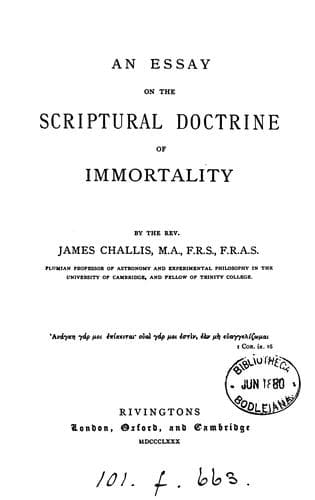
An Essay on the Scriptural Doctrine of Immortality — John Shaqi
An Essay on the Scriptural Doctrine of ImmortalityChallis, James
Religion
An Essay on the Scriptural Doctrine of Immortality
Challis, James
Immortality
It only remains now to speak of the final issue of {71} the judgment
stated thus in _v._ 46: "And these shall go away into eternal
punishment, but the righteous into external life." It must be admitted
that the first clause of this sentence, taken as it is usually taken,
expresses the perpetuity of evil, inasmuch as "punishment" is an evil.
But after this has been conceded, there is still something more to be
said on this doctrine. It is evident from the context that by "these"
is meant the ungodly just before spoken of, who, having shown, by their
neglecting to give proof of love towards their neighbours, that the
love of God is not in them (see 1 John iv. 20), are counted as enemies,
and as such must be punished. For there is no neutral position: all
who do not obey the commands of Christ are opposed to him, and all that
is opposed to him is destined to be brought under subjection. Further,
it is to be noticed that although the final decision is expressed
generally in accordance with the before-mentioned principle of
employing exactly opposite terms relatively to the righteous and the
wicked, here the opposite of "eternal life" is "eternal punishment,"
and not "eternal death," the latter expression being nowhere found in
Scripture. May it not hence be argued that, as among men the
punishment of the guilty has not for its purpose the infliction of pain
and penalty, but rather is the means employed to the end that laws may
be obeyed, so the end of divine punishment is for correction, and for
{72} giving effect to and establishing the law of universal
righteousness. If it should hence be inferred that the word "eternal"
is applied to future punishment with reference to that permanence of
_effect_ which, as has already been indicated (p. 65), is symbolically
represented by the perpetual ascent of "the smoke of torment," against
this inference it might reasonably be urged that "eternal" ought to be
taken in the same sense relatively to the "punishment" of the wicked,
as relatively to the "life" of the righteous, and eternity is here
predicated of the one just as of the other. Now, although this
reasoning appears to be irrefragable, the additional arguments from
Scripture which I am about to adduce will, I think, show that there
must be some other way of regarding the doctrine of future punishment,
which, although not inconsistent with that to which the foregoing
interpretation of Matt. xxv. 46 has conducted, differs from it either
as to point of view or comprehensiveness.
Public-domain text, read in full here on John Shaqi.
Reviews
Reviews
No reviews yet
Be the first to share your thoughts on this work.
Join the Discussion
Join the discussion
Sign in to leave a comment or review.
Sign InorCreate an account