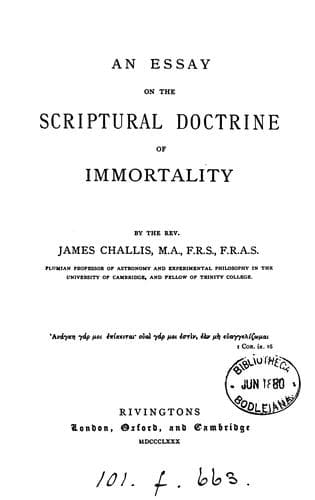
An Essay on the Scriptural Doctrine of Immortality — John Shaqi
An Essay on the Scriptural Doctrine of ImmortalityChallis, James
Religion
An Essay on the Scriptural Doctrine of Immortality
Challis, James
Immortality
In the first place, it is to be observed that in our Lord's discourses
doctrine was very generally taught by parables and symbolic language,
which required to be interpreted in order that the abstract and
spiritual truths thereby conveyed might be understood. (This remark
applies to the whole of the passage, Matt. xxv. 31-46, brought under
review in the foregoing discussion.) In Mark iv. 34, it is said that
"without a parable he spake not to them," that is, {73} to the
multitude, and that "in private he explained all things to his
disciples." Being asked by the disciples, when he was preaching to a
great multitude assembled together on the sea-shore to hear him, why he
spake to them in parables, he answered, "Because it is given to you to
know the mysteries of the kingdom of heaven, but to them it is not
given. For whosoever hath, to him it shall be given, and he shall have
more abundance; but whosoever hath not, from him shall be taken away
even that he hath. Therefore speak I to them in parables, because
seeing they see not, and hearing they hear not, neither do they
understand" (Matt. xiii. 10-13). It is here affirmed that although
parables from their very character are expressed in terms which the use
of the senses renders intelligible, there are those who do not or will
not understand them, who for this reason, on the principle of not
giving to those who have not, are spoken to only in parables, so that
they continue in ignorance. As every effect or consequence implies the
antecedence of the _purpose_ of an agent, with respect to this
consequence we find it stated in Luke viii. 10, that our Lord expressly
addressed the disciples in these words: "Unto you it is given to know
the mysteries of the kingdom of God, but to the rest in parables, _that
seeing they may not see, and hearing they may not understand_." To a
selected few is granted the favour of being able to discern, _through
the objective sense_ of {74} parables, the interior signification
whereby mysteries of the kingdom of God are revealed, whilst from the
rest--the multitude--although the objective sense is the same to them
as to the others, the knowledge of the mysteries is withheld. This is
evidently a dispensation analogous to that according to which, as
Christ declared, "Many are called, but few are chosen" (Matt. xxii.
14). It is also in accordance with views expressed in a previous part
of this Essay respecting the distinction between "the elect" and the
rest of mankind.
Public-domain text, read in full here on John Shaqi.
Reviews
Reviews
No reviews yet
Be the first to share your thoughts on this work.
Join the Discussion
Join the discussion
Sign in to leave a comment or review.
Sign InorCreate an account