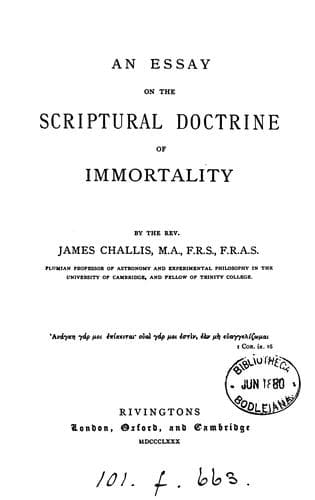
An Essay on the Scriptural Doctrine of ImmortalityChallis, James
Religion
An Essay on the Scriptural Doctrine of Immortality
Challis, James
Immortality
It is further to be considered that the Lord promised the apostles that
after his departure from them, "the Holy Spirit would teach them all
things, and bring all things to their remembrance which he had said to
them" (John xiv. 26), and it may be assumed that after the Day of
Pentecost this promise was fulfilled, and that they were then
enlightened to discern the spiritual meaning of his doctrine. In this
way it may be accounted for that while Christian doctrine rests
fundamentally on the words and deeds of Christ as recorded in the
Gospels, it is taught in the Acts of the Apostles and the apostolical
Epistles in terms of a more abstract character, which, in fact, may be
regarded as unfolding the spiritual import of the teaching, the life,
and the death of Jesus Christ. The apostle Paul, although he was not
one of the originally selected apostles, had special grace and {75}
power given him for understanding fully and teaching the doctrine of
Christ. Now, this apostle, so gifted with understanding and knowledge,
writes in his Epistle to the Romans: "By the obedience of one shall the
many be made righteous" (v. 19); the context evidently showing that the
"one" is Jesus Christ, and that "the many" are _all_ the sinful sons of
Adam. I have already adverted to this text (p. 19), and called
attention to the significance of the future tense, "shall be made
righteous." According to our argument, when they have been made
righteous, they are _saved_. Hence, quite consistently with this
passage in the Epistle to the Romans, St. Paul has said in his first
Epistle to Timothy (iv. 10), "We trust in the living God, who is the
Saviour of all men, especially of those that believe." If this
sentence had not contained the last clause, there might have been some
excuse for questioning whether St. Paul preached the doctrine of the
eventual salvation of all men; but inasmuch as he adds, "especially of
those that believe," it is as clear as words can make anything clear,
that he taught that all are saved in the sense in which he taught that
those who believe are saved. The reason for making the distinction
expressed by the word "especially" is, I think, sufficiently apparent
from the doctrine, previously maintained in this Essay (pp. 88-40),
that the elect righteous are raised up first, and partake already of
salvation, honour, {76} and glory, during a certain interval preceding
the resurrection of the rest of mankind.
Public-domain text, read in full here on John Shaqi.
Reviews
Reviews
No reviews yet
Be the first to share your thoughts on this work.
Join the Discussion
Join the discussion
Sign in to leave a comment or review.
Sign InorCreate an account