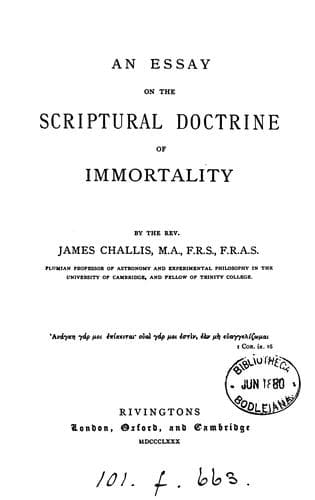
An Essay on the Scriptural Doctrine of ImmortalityChallis, James
Religion
An Essay on the Scriptural Doctrine of Immortality
Challis, James
Immortality
Now, since all that are saved, as being at rest and in felicity, are
free from sin and evil, this teaching of St. Paul is directly opposed
to the doctrine of the perpetuity of evil which is usually inferred
(see p. 71) from the saying of our Lord in Matt. xxv. 46. Thus
apparently there is irreconcilable contradiction between the teaching
of Christ and the teaching of St. Paul on a most momentous subject.
Since, however, the same spirit of wisdom was in the apostle as in his
Lord, it is not possible that there can really be such contradiction;
and because, consequently, the seeming contradiction must be
attributable to our defect of knowledge, or inability, to interpret
rightly the allegorical teaching of Christ, we might do well, although
no solution of the difficulty should be at hand, to accept this gospel
of salvation, in the confidence that, as being declared by St. Paul in
plain terms, it must be true Christian doctrine.
I am not, however, prepared to grant that the solution of the
above-mentioned difficulty is not discoverable; and accordingly I make
bold to indicate a line of argument by which, as it seems to me, a
solution is attainable. The first step in this argument is to admit
the reality of that analogy between God's natural creation and His
spiritual creation which has already been taken into consideration (see
p. 14), {77} and to infer therefrom that the spiritual creation is
actually in progress towards a foreordained perfect consummation. For
the purpose of illustrating this view by way of contrast, I may mention
that I once heard a sermon in which the preacher, who was regarded in
his day as a leader of religious thought, advanced the theory that the
word "remedy" expressed the central idea of the divine scheme of
salvation. According to this theology, which looks backwards rather
than forwards, the prevalence of sin and mortality, and the need of a
remedy for the many ills and errors that beset humanity, were
contingent on Adam's transgression. It may be granted that this is so
far true, that sin and death entered into the world because Adam was
not made incapable of sinning. But this theory overlooks the
possibility of there being a _final_ cause for the actual facts of
humanity, and seems to be a substitution of _propter hoc_ for _post
hoc_. The analogy of the natural creation points to a different, and
apparently a juster, view of the divine [oe]conomy, according to which
the reign of sin and death in Adam and all his posterity is a necessary
part of a prearranged scheme, now actually in progress, which is
destined, by its completion hereafter, to make, not one man only, but a
countless multitude, incapable of sinning and meet for immortality. On
this point, however, after what has been already said (see p. 57),
there is no occasion to say {78} more here. I proceed, therefore, to
the next step, which is to indicate certain inferences that may be
Public-domain text, read in full here on John Shaqi.
Reviews
Reviews
No reviews yet
Be the first to share your thoughts on this work.
Join the Discussion
Join the discussion
Sign in to leave a comment or review.
Sign InorCreate an account