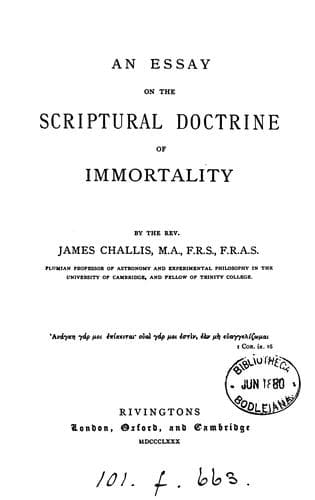
An Essay on the Scriptural Doctrine of ImmortalityChallis, James
Religion
An Essay on the Scriptural Doctrine of Immortality
Challis, James
Immortality
drawn from the character of progressiveness which pertains at present
to the spiritual creation.
It may, in the first place, be asserted that "the law of opposites,"
referred to in pp. 69 and 70, is a necessary accompaniment of that
general law of progression. The author of the Book of Ecclesiasticus,
who certainly put on record many wise sayings, has thus stated the law
of opposites: "Good is set against evil, and life against death: so is
the sinner against the godly. So look upon all the works of the Most
High, and there are two and two, one against another" (xxxiii. 14, 15).
Now, evidently this duality will cease, and unity be universally
established, when, as argued in the preceding paragraph, the
predestined consummation is reached, and the purpose of the whole
creation, external and spiritual, is fulfilled. This doctrine of the
termination of evil appears to have been understood and proclaimed by
the writer of the fourth Book of Esdras, in which we meet with the
following emphatic declaration: "Take heaven and earth to witness; for
I have broken the evil in pieces, and created the good: for I live,
saith the Lord" (ii. 14). In the mean while, as being subject to
conditions of earth, and time, and space, we are also subject to this
law of duality and antagonism, so that we have no knowledge or
perception of anything of {79} which we do not also know the
_opposite_. For this reason it is not possible to make known the
conditions under which men are saved without at the same time stating
the conditions under which they are _not_ saved. This will account for
the _oppositeness_ and _parallelism_ of the statements in Matt. xxv.
46, concerning the consequences to the wicked and the righteous of
their respective deeds, as well as for many statements of like
character in other parts of Scripture. But this does not explain why
the punishment of the wicked is said to be "eternal." Relatively to
this question I submit the following considerations.
Public-domain text, read in full here on John Shaqi.
Reviews
Reviews
No reviews yet
Be the first to share your thoughts on this work.
Join the Discussion
Join the discussion
Sign in to leave a comment or review.
Sign InorCreate an account