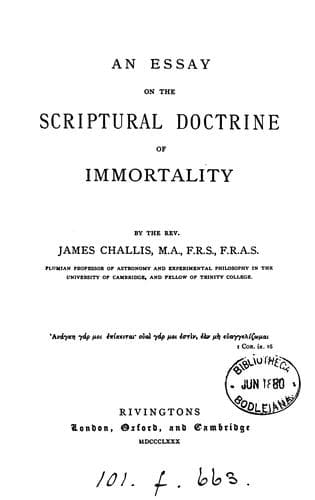
An Essay on the Scriptural Doctrine of ImmortalityChallis, James
Religion
An Essay on the Scriptural Doctrine of Immortality
Challis, James
Immortality
Recurring once more to the position, that the existing order of things
is part of a progressive scheme, the purpose of which is to create
immortal souls, it may, I think, be reasonably assumed that there is
nothing in human cognizance or experience, whether it be thought or
feeling, word or deed, which is not contributory in some manner to this
end. If a mechanist, after planning a machine for a certain purpose,
introduced in the execution of it parts which contributed nothing
towards effecting that purpose, would not this be considered to be an
imperfection? Such imperfection is wholly inadmissible in the
workmanship of an omniscient and omnipotent Creator. Accordingly,
since, as being conditioned by _time_, we are capable of entertaining
the thought that the punishment of the wicked in the world to come may
{80} be eternal, many, in fact, having professed their belief that so
it will be, we must conclude, on the above principle, that even this
thought is contributory towards the eventual bringing in of
immortality. But it will be asked, in what way? To this question we
may give the general answer, that as such thought is operative on human
action, and implies the existence of _time_, it must be reckoned as
part of the total of human thought and experience conditioned by time,
which was ordained from the beginning to be the means, whether in this
age or in the age to come (_aion ho mellon_), of forming spirits for
immortality. Then, again, we have reason from Scripture to infer that
the immortal spirit is in effect "spiritual _body_" (1 Cor. xv. 44),
composed of functional parts or qualities constituting it such a whole
that it is adapted for communion with other spirit; in which case the
_temporal_ processes of creation above mentioned might be supposed to
be designed to give to immortal spirit a character appropriate to its
destiny. And we may, at least, be certain that Jesus Christ knew what
was required for accomplishing his Father's purpose of creating spirits
which, while retaining _individuality_ and _will_, would be incapable
of sinning, and that in his wisdom he employed such manner of teaching
as would either now or hereafter conduct to that end.
Public-domain text, read in full here on John Shaqi.
Reviews
Reviews
No reviews yet
Be the first to share your thoughts on this work.
Join the Discussion
Join the discussion
Sign in to leave a comment or review.
Sign InorCreate an account