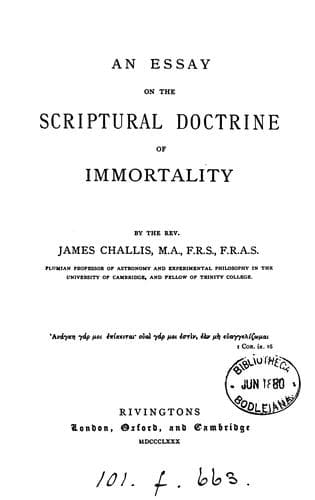
An Essay on the Scriptural Doctrine of ImmortalityChallis, James
Religion
An Essay on the Scriptural Doctrine of Immortality
Challis, James
Immortality
I take occasion to observe here, parenthetically, that whereas,
according to the above argument, the {81} word "eternal" (from
_[oe]etas_) is applicable to punishment because we can think of eternal
punishment by thinking of time, the word "endless" is not in the same
manner applicable, simply because it does not explicitly indicate
relation to _time_. The Greek equivalent of the English word
"everlasting," and of the Latin word "_sempiternus_," namely _aidios_
from _aei_, is used in Rom. i. 20, and in Jude 6, in the sense of
_aionios_, and, as involving like the latter the conception of time, is
similarly applicable to future punishment. But besides "_eternal_
life," we have in Scripture "_indissoluble_ life" (_xon akatalytos_,
Heb. vii. 16), the remarkable epithet _akatalytos_ not being
etymologically expressive of time, and therefore not wrongly, although
not strictly, translated by "endless" in the Authorized Version. No
such epithet is applied in Scripture to "punishment" or "torment."
(See more on this question in an Appendix to the Essay.)
Reasoning analogous to that employed above relative to the assertion in
Matt. xxv. 46, that the wicked "go away into eternal punishment," is
applicable to other declarations of like tenor in various portions of
Scripture. One of these, recorded in Matt. xxvi. 24 as having been
spoken by the Lord to the "_twelve_," demands special notice.
Translated literally according to the tenses of the Greek, this passage
is, "Woe to that man through whom the Son of man has been betrayed!
good was it for him, if that man was not {82} born." The translation
in the Authorized Version, "it had been good for that man if he had not
been born," may be taken to convey, regard being had to difference of
idiom, the true sense of the original. Exactly the same passage occurs
in Mark xiv. 21, where our translators have given, "good were it for
that man if he had never been born." Although this translation, as
containing the word "never," deviates still more than the other from
the literal rendering, it may be justified on the principle that the
declaration, in whatever form it be made, is one in which _time_ enters
as a necessary element, whereby alone it is within the reach of
thought. Accordingly, this saying of our Lord, regarded as having
relation to experience in the world to come, is in the same category as
his assertion of the eternity of future punishment, and would appear,
by applying the argument already expounded (p. 80) with respect to that
doctrine, to be in like manner contributory towards generating in the
spirit of man an incapability of sinning. It is farther to be taken
into account that these words were addressed by the Lord to his
_apostles_--to the elect of the elect--with particular reference to the
sin of _betraying_ the Son of man, which was exemplified by the outward
act of Judas, who also by his self-destruction exhibited the damnatory
power of the inward consciousness of such guilt.
Public-domain text, read in full here on John Shaqi.
Reviews
Reviews
No reviews yet
Be the first to share your thoughts on this work.
Join the Discussion
Join the discussion
Sign in to leave a comment or review.
Sign InorCreate an account