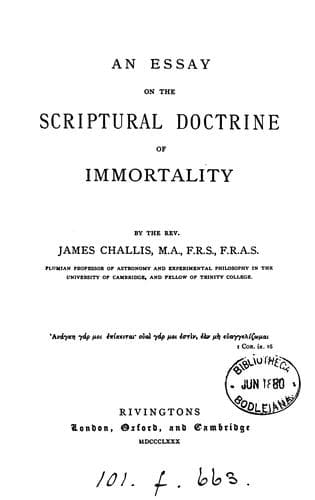
An Essay on the Scriptural Doctrine of ImmortalityChallis, James
Religion
An Essay on the Scriptural Doctrine of Immortality
Challis, James
Immortality
Analogous principles may be applied to account for the declarations
made in Scripture respecting blasphemy against the Holy Spirit. In St.
Matt. xii. 31, 82, it is recorded that our Lord said, "All sin and
blasphemy shall be forgiven to men, but the blasphemy of the Spirit
shall not be forgiven to men. And whoever speaketh a word against the
Son of man, it shall be forgiven him; but whoever speaketh against the
Holy Spirit, it shall not be forgiven him, {85} neither in this world,
nor in the world to come." The same doctrine is thus expressed in St.
Mark iii. 28, 29: "Verily I say to you, all sins shall be forgiven to
the sons of men, and all blasphemies whatever wherewith they may
blaspheme. But whoever shall blaspheme against the Holy Ghost hath
never forgiveness," but is subject to the judgment in the future _aion_
(_enochos estin aioniou kriseos_). From the latter evangelist we also
learn that our Lord spoke these words because the scribes from
Jerusalem had said, "He hath an unclean spirit." It is particularly to
be noticed that both passages declare in the fullest manner that all
manner of sin and blasphemy shall be forgiven to men, at the same time
that they pronounce that blasphemy (not sin, _amartia_) against the
Holy Ghost is not forgiven. To account for this apparent
contradiction, it must be remembered that the forgiveness, or
_remission_ (_aphesis_) of sin, necessarily implies antecedence of law
and transgression of the law; and whereas St. Paul teaches that "the
law entered that transgression might abound" (Rom. v. 20), it is quite
consistent with this doctrine to find that in the gospel of Christ
provision is made for the remission of all sin and blasphemy. Now,
such remission consists in "repentance towards God and faith towards
our Lord Jesus Christ" (Acts xx. 21); and therefore, when the gift of
righteousness (i.e. the grace of Christ) is received, the believer
begins to partake {86} of a spirit such as that which was "without
measure" in Christ. This is essentially a _holy_ spirit, the
antecedent of which in Jesus Christ was perfect righteousness.
Therefore the scribes blasphemed when they said of Christ, "He hath an
unclean spirit," it not being possible that a perfectly righteous body
can be the vessel of an unclean spirit.
Public-domain text, read in full here on John Shaqi.
Reviews
Reviews
No reviews yet
Be the first to share your thoughts on this work.
Join the Discussion
Join the discussion
Sign in to leave a comment or review.
Sign InorCreate an account