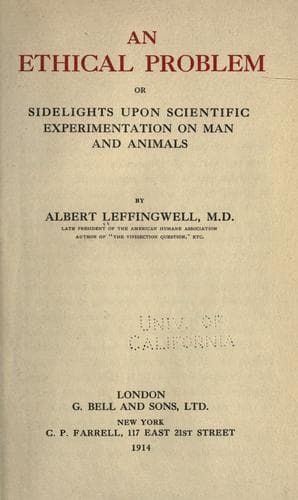
An ethical problem; or, Sidelights upon scientific experimentation on man and animalsLeffingwell, Albert
Philosophy
An ethical problem; or, Sidelights upon scientific experimentation on man and animals
Leffingwell, Albert
Medicine, Experimental; Vivisection
Magendie left us a singularly truthful estimate of his own character
and of his scientific accomplishments when he declared himself to be
simply "a street scavenger (un chiffonier) of science. With my hook
in my hand and my basket on my back, I ramble about the streets of
science and gather up whatever I can find." The comparison was
singular, but it was apt; he was, indeed, the ragpicker of
physiology. With a scavenger's sense of honour he endeavored to rob
Sir Charles Bell of the credit for his discovery concerning the
functions of the spinal nerves, by a prodigality of torment, from
which the nobler nature of the English scientist instinctively
recoiled. When there came to him an opportunity of experimenting on
man, he embraced it with avidity, and again and again, while operating
for cataract, plunged his needle to the bottom of the patient's eye,
that he might learn the effect of mechanical irritation of the
delicate organ of sight.[1] Some rags and tatters of physiology he
bought--at the price of immeasurable torment--and held them up for the
admiration of his contemporaries; but in the great conflict with
disease and death it may be questioned whether he added a single fact
that has increased the potency of medical art, the length of human
life, or the sum of human happiness.
[1] Magendie naturally had no hesitancy in telling of these
experiments made upon his patients "at the clinique of my hospital."
See his "Elementary Treatise on Physiology" (translated by Dr. John
Revere). New York, 1844, p. 64.
Such was Franc,ois Magendie, physiologist and torturer, judged by
scientific men and physiologists of a higher race, to whom compassion
was not unknown. For undisguised contempt of pity, for delight in
cruelty, for the infliction of refined and ingenious torment, he may
have been equally by some who followed and imitated him, but certainly
he was never surpassed.
Another distinguished French chiffonier in the slum-districts of
scientific exploration was Dr. L. J. Brachet, a contemporary of
Magendie. In his day he was a man of extended reputation as a
vivisector of animals. His principal work is entitled: "Recherches
Expe'rimentales de Syste`me Nerveux...par J. L. Brachet, Membre de
l'Acade'mie Royale de Me'decine" and member of similar academies at
Berlin, Copenhagen, and elsewhere; member of various medical societies
of Paris, Lyons, Bordeaux, and Marseilles--the title-page of his book
records his fame. It will be of interest to study the character of
the experimentation, recorded by himself, upon which rests his
eminence as a scientific man.
Public-domain text, read in full here on John Shaqi.
Reviews
Reviews
No reviews yet
Be the first to share your thoughts on this work.
Join the Discussion
Join the discussion
Sign in to leave a comment or review.
Sign InorCreate an account