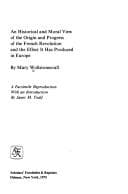
An historical and moral view of the origin and progress of the French Revolution; and the effect it has produced in EuropeWollstonecraft, Mary
Philosophy
An historical and moral view of the origin and progress of the French Revolution; and the effect it has produced in Europe
Wollstonecraft, Mary
France -- History -- Revolution, 1789-1799 -- Causes
It is a vulgar errour, built on a superficial view of the subject,
though it seems to have the sanction of experience, that civilization
can only go as far as it has hitherto gone, and then must necessarily
fall back into barbarism. Yet thus much appears certain, that a state
will infallibly grow old and feeble, if hereditary riches support
hereditary rank, under any description. But when courts and
primogeniture are done away, and simple equal laws are established, what
is to prevent each generation from retaining the vigour of youth?—What
can weaken the body or mind, when the great majority of society must
exercise both, to earn a subsistence, and acquire respectability?
The french revolution is a strong proof how far things will govern men,
when simple principles begin to act with one powerful spring against the
complicated wheels of ignorance; numerous in proportion to their
weakness, and constantly wanting repair, because expedients of the
moment are ever the spawn of cowardly folly, or the narrow calculations
of selfishness. To elucidate this truth, it is not necessary to rake
among the ashes of barbarous ambition; to show the ignorance and
consequent folly of the monarchs, who ruled with a rod of iron, when the
hordes of european savages began to form their governments; though the
review of this portion of history would clearly prove, that narrowness
of mind naturally produces ferociousness of temper.
We may boast of the poetry of those ages, and of those charming flights
of imagination, which, during the paroxysms of passion, flash out in
those single acts of heroic virtue, that throw a lustre over a whole
thoughtless life; but the cultivation of the understanding, in spite of
these northern lights, appears to be the only way to tame men, whose
restlessness of spirit creates the vicious passions, that lead to
tyranny and cruelty. When the body is strong, and the blood warm, men do
not like to think, or adopt any plan of conduct, unless broken-in by
degrees: the force that has often spent itself in fatal activity becomes
a rich source of energy of mind.
Men exclaim, only noticing the evil, against the luxury introduced with
the arts and sciences; when it is obviously the cultivation of these
alone, emphatically termed the arts of peace, that can turn the sword
into a ploughshare. War is the adventure naturally pursued by the idle,
and it requires something of this species, to excite the strong emotions
necessary to rouse inactive minds. Ignorant people, when they appear to
reflect, exercise their imagination more than their understanding;
indulging reveries, instead of pursuing a train of thinking; and thus
grow romantic, like the croisaders; or like women, who are commonly idle
and restless.
Public-domain text, read in full here on John Shaqi.
Reviews
Reviews
No reviews yet
Be the first to share your thoughts on this work.
Join the Discussion
Join the discussion
Sign in to leave a comment or review.
Sign InorCreate an account