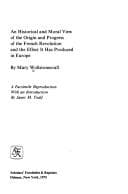
An historical and moral view of the origin and progress of the French Revolution; and the effect it has produced in EuropeWollstonecraft, Mary
Philosophy
An historical and moral view of the origin and progress of the French Revolution; and the effect it has produced in Europe
Wollstonecraft, Mary
France -- History -- Revolution, 1789-1799 -- Causes
Having written on a subject, that naturally attracted the attention of
the public, he had the vanity to believe, that he deserved the
exaggerated applause he received, and the reputation of wise, when he
was only shrewd. Not content with the fame he acquired by writing on a
subject, which his turn of mind and profession enabled him to
comprehend, he wished to obtain a higher degree of celebrity, by forming
into a large book various metaphysical shreds of arguments, which he had
collected from the conversation of men, fond of ingenious subtilties;
and the style, excepting some declamatory passages, was as inflated and
confused as the thoughts were far fetched and unconnected[7].
As it is from this period, that we must date the commencement of those
great events, which, outrunning expectation, have almost rendered
observation breathless, it becomes necessary to enter on the task with
caution; as it ought not to be more the object of the historian to fill
up the sketch, than to trace the hidden springs and secret mechanism,
which have put in motion a revolution, the most important that has ever
been recorded in the annals of man. This was a crisis that demanded
boldness and precision; and no man in France, excepting Necker, had the
reputation of possessing extensive political talents; because the old
system of government scarcely afforded a field, in which the abilities
of men could be unfolded, and their judgment matured by experience. Yet,
whilst the kingdom was in the greatest fermentation, he seems to have
thought of none but those timid half-way measures, which always prove
disastrous in desperate cases, when the wound requires to be probed to
the quick.
The old government was then only a vast ruin; and whilst it’s pillars
were trembling on their baseless foundations, the eyes of all France
were directed towards their admired minister. In this situation, with
all his former empiricism he began his second career, like another
Sangrado. But the people could no longer bear bleeding—for their veins
were already so lacerated, it was difficult to find room to make a fresh
incision; and the emollient prescriptions, the practice of former times,
were now insufficient to stop the progress of a deadly disease. In this
situation, listening to the voice of the nation, because he was at a
loss what step to take to maintain his popularity, he determined to
hasten the convocation of the states-general: first recalling the exiled
magistrates, and restoring the parliaments to the exercise of their
functions. His next care was to dissipate all apprehension of a famine;
a fear that had been artfully excited by the court agents, in order to
have a pretext to form magazines of provision for an army, which they
had previously resolved to assemble in the vicinity of Paris.
Public-domain text, read in full here on John Shaqi.
Reviews
Reviews
No reviews yet
Be the first to share your thoughts on this work.
Join the Discussion
Join the discussion
Sign in to leave a comment or review.
Sign InorCreate an account