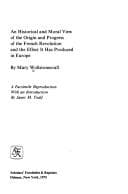
An historical and moral view of the origin and progress of the French Revolution; and the effect it has produced in Europe — John Shaqi
An historical and moral view of the origin and progress of the French Revolution; and the effect it has produced in EuropeWollstonecraft, Mary
Philosophy
An historical and moral view of the origin and progress of the French Revolution; and the effect it has produced in Europe
Wollstonecraft, Mary
France -- History -- Revolution, 1789-1799 -- Causes
The clergy, however, divided in their interest, proceeded with more
caution; and the most discerning of them, perceiving that their order
was becoming obnoxious to the people, who now deified the third-estate,
proposed a committee of conciliation, with a view, as they pretended, to
promote a good understanding between all parties. The king also, in his
turn, when the nobles rejected the mediation of the clergy, offered a
plan of accommodation; a mighty nothing, that the court brought
forth.—But this tub, thrown out to the whale, did not divert the
attention of either party from the main object; though the nobles, many
of whom were in the secret of the approach of the army, should things be
carried to extremes, pretended to acquiesce; yet guarding carefully at
the same time all their ancient pretentions: and this insincerity drew
on them the universal odium they merited, mixed with the contempt which
ineffectual struggles always produce. Conciliatory measures, in fact,
were only a solemn farce at this time; though the clergy, rather
insidiously, to ingratiate themselves with the people, lamenting the
high price of bread, requested, that deputies from the three orders
should meet to deliberate how this grievance might be lessened. The
deputies of the commons, with becoming dignity, tempered with prudence,
adhered to their point; and dexterously parrying off the artful stroke
levelled at their popularity, they represented to the clergy, that this
was another powerful motive, to make them entreat all parties to rally
round the same point, to remedy evils, which excited equal sympathy in
their bosoms.
The inactivity occasioned by these disputes could not fail to inflame
the public mind, especially as fresh publications were daily affording
it fuel. For the liberty of the press was now tacitly established, and
the freest sentiments uttered, with the heat of superficial knowledge,
in defiance of court manifestoes. Still, as a proof that the court
merely endured, for a season, what they could not prevent, the journal
of the proceedings of the states-general was stopped, by an express
order; to evade which it was continued in the form of letters from
Mirabeau to his constituents.
Public-domain text, read in full here on John Shaqi.
Reviews
Reviews
No reviews yet
Be the first to share your thoughts on this work.
Join the Discussion
Join the discussion
Sign in to leave a comment or review.
Sign InorCreate an account