An Historical Sketch of Sacerdotal Celibacy in the Christian Church — John Shaqi
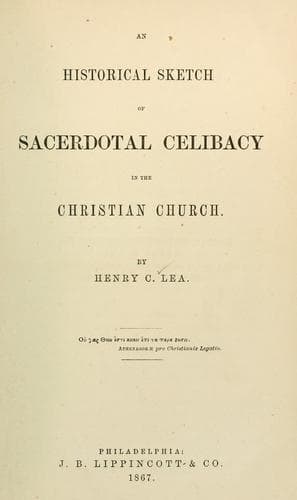
An Historical Sketch of Sacerdotal Celibacy in the Christian ChurchLea, Henry Charles
History
An Historical Sketch of Sacerdotal Celibacy in the Christian Church
Lea, Henry Charles
Catholic Church -- Clergy; Celibacy -- Catholic Church; Church history
Although no thought existed in the mind of Paul, and of his co-laborers
in founding the church of the Gentiles, of prohibiting to his disciples
the institution of marriage, there was a distinct flavor of asceticism
in some of his teachings, which might readily serve as a warrant to
those whose zeal was greater than their discretion, to mortify the
flesh in this as in other ways. The Apostle, while admitting that the
Lord had forbidden the separation of husband and wife, said of the
unmarried and widowers:
“It is good for them if they abide even as I. But if they cannot
contain let them marry, for it is better to marry than to burn.”
And though in one passage he seems to indicate a belief that woman
could only be saved by maternity from the punishment incurred by
the disobedience of Eve, in another he formally declares that “he
that giveth her in marriage doeth well; but he that giveth her not
in marriage doeth better,” thus showing a marked preference for the
celibate state, in which the devout could give themselves up wholly to
the service of the Lord.[29]
The Apostle’s discussion of these subjects shows that already there
had commenced a strong ascetic movement, raising questions which he
found hard to answer, without on the one hand repressing the ardor of
serviceable disciples, and on the other, imposing burdens on neophytes
too grievous to be borne. He foresaw that the former would soon run
beyond the bounds of reason, and he condemned in advance the heresies
which should forbid marriage;[30] but that the tendency of the faithful
lay in that direction was inevitable. In those times, no one would
join the infant church who did not regard the things of earth as
vile in comparison with the priceless treasures of heaven, and the
more fervent the conviction, the more it was apt to find expression
in mortifying the flesh and purchasing salvation by the sacrifice of
passions and affections. Such especially would be the tendency of the
stronger natures which lead their fellows; and the admiration of the
multitude for their superior virtue and fortitude would soon invest
them with a reputation for holiness which would render them doubly
influential.
Public-domain text, read in full here on John Shaqi.
Reviews
Reviews
No reviews yet
Be the first to share your thoughts on this work.
Join the Discussion
Join the discussion
Sign in to leave a comment or review.
Sign InorCreate an account