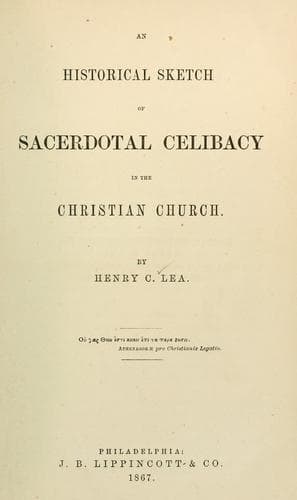
An Historical Sketch of Sacerdotal Celibacy in the Christian ChurchLea, Henry Charles
History
An Historical Sketch of Sacerdotal Celibacy in the Christian Church
Lea, Henry Charles
Catholic Church -- Clergy; Celibacy -- Catholic Church; Church history
There was much, indeed, in the teaching of the church, and in its
relations with the Gentiles, to promote and strengthen this tendency.
The world into which Christianity was born was hopelessly corrupt.
Licentiousness, probably, has never been more defiant than amid
the splendors of the early Empire. The gossip of Suetonius and the
denunciations of Juvenal depict a society in which purity was scarce
understood, and in which unchastity was no sin and hardly even a
reproach. To reclaim such a population needed a new system of morality,
and it is observable that in the New Testament particular stress is
laid upon the avoidance of fornication, especially after the faith had
begun to spread beyond the boundaries of Judea. The early Christians
thus were a thoroughly puritan sect, teaching by example as well as by
precept, and their lives were a perpetual protest against the license
which reigned around them.[31] It therefore was natural that converts,
after their eyes were opened to the hideous nature of the prevailing
vices, should feel a tendency to plunge into the other extreme, and
should come to regard even the lawful indulgence of human instincts as
a weakness to be repressed. Civilization, indeed, owes too much to the
reform which Christianity rendered possible in the relations of the
sexes, for us to condemn too severely even the extravagances into which
it was sometimes betrayed.
That it was becoming not uncommon for Christians to follow a celibate
life is shown by various passages in the early fathers. St. Ignatius
alludes to abstinence from marriage in honor of God as a matter not
uncommon, but which was wholly voluntary and to be practised in
humility and secrecy, for the virtue of continence would be much more
than counterbalanced by the sin of pride.[32] The Apologists, Justin
Martyr about the year 150, Athenagoras about 180, and Minucius Felix
about 200, all refer to the chastity and sobriety which characterized
the sect, the celibacy practised by some members, and the single
marriage of others, of which the sole object was the securing of
offspring and not the gratification of the passions. Athenagoras,
indeed, condemns the exaggerations of asceticism in terms which show
that already they had made their appearance among the more ardent
disciples, but that they were strongly disapproved by the wiser portion
of the Church. Origen seems to regard celibacy as rather springing
from a desire to serve God without the interruptions arising from
the cares of marriage than from asceticism, and does not hesitate
to condemn those who abandoned their wives even from the highest
motives.[33] The impulse towards asceticism, however, was too strong
to be resisted. Zealots were not wanting who boldly declared that to
follow the precepts of the Creator was incompatible with salvation,
as though a beneficent God should create a species which could only
preserve its temporal existence by forfeiting its promised eternity.
Public-domain text, read in full here on John Shaqi.
Reviews
Reviews
No reviews yet
Be the first to share your thoughts on this work.
Join the Discussion
Join the discussion
Sign in to leave a comment or review.
Sign InorCreate an account