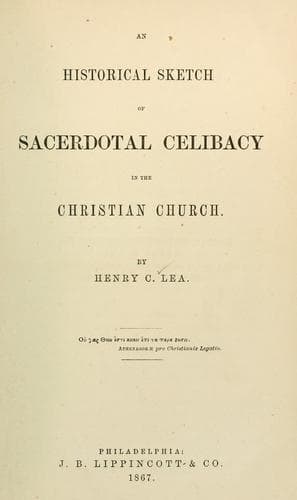
An Historical Sketch of Sacerdotal Celibacy in the Christian ChurchLea, Henry Charles
History
An Historical Sketch of Sacerdotal Celibacy in the Christian Church
Lea, Henry Charles
Catholic Church -- Clergy; Celibacy -- Catholic Church; Church history
Ambitious men were to be found who sought notoriety or power by the
reputation to be gained from self-denying austerities, which brought to
them followers and believers venerating them as prophets. Philosophers
were there, also, who, wearied with the endless speculations of
Pythagorean and Platonic mysticism, sought relief in the practical
morality of the Gospel, and perverted the simplicity of its teachings
by interweaving with it the subtle philosophy of the schools, producing
an apparent intoxication which plunged them either into the grossest
sensuality or the most rigorous asceticism. Such were Julian Cassianus,
Saturnilus, Marcion, the founder of the Marcionites, Tatianus, the
heresiarch of the Encratitians, and the unknown authors of a crowd of
sects which, under the names of Abstinentes, Apotactici, Excalceati,
etc., practised various forms of self-mortification, and denounced
marriage as a deadly sin.[34] Such, on the other hand, were Valentinus
and Prodicus who originated the mystic libertinism of the Gnostics;
Marcus, whose followers, the Marcosians, were accused of advocating
the most disgusting practices, Carpocrates who held that the soul was
obliged to have experience of all manner of evil before it could be
elevated to God; Basilides whose sectaries honored the passions as
emanating from the Creator, and taught that their impulses were to be
followed. Even the Ebionites did not escape the taint, if Epiphanius
is to be believed; and there was also a sect advocating promiscuous
intercourse, to whom the name of Nicolites was given in memory of the
story of Nicholas, the deacon of the primitive church, who offered
to his fellow-disciples the wife whom he was accused of loving with
too exclusive a devotion—a sect which merited the reproof of St.
John, and which has a special interest for us because in the eleventh
century all who opposed clerical celibacy were branded with its name,
thus affording to the sacerdotal party the inestimable advantage of
stigmatizing their antagonists with an opprobrious epithet of the most
damaging character, and of invoking the authority of the Apocalypse for
their destruction.[35]
Public-domain text, read in full here on John Shaqi.
Reviews
Reviews
No reviews yet
Be the first to share your thoughts on this work.
Join the Discussion
Join the discussion
Sign in to leave a comment or review.
Sign InorCreate an account