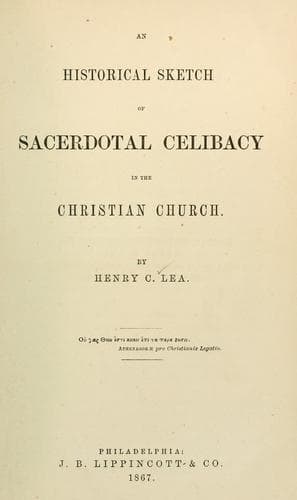
An Historical Sketch of Sacerdotal Celibacy in the Christian ChurchLea, Henry Charles
History
An Historical Sketch of Sacerdotal Celibacy in the Christian Church
Lea, Henry Charles
Catholic Church -- Clergy; Celibacy -- Catholic Church; Church history
The church was too pure to be led astray by the libertinism of the
latter class of heresiarchs. The time had not yet come for the former,
and men who, in the thirteenth century, might perhaps have founded
powerful orders, and have been reverenced by the Christian world as new
incarnations of Christ, were, through their anachronism, stigmatized
as heretics, and expelled from the communion of the faithful. Still,
their religious fervor and rigorous virtue had a gradually increasing
influence in stimulating the development of the ascetic principle,
if not in the acknowledged dogmas, at all events, in the practice
of the church, as may be seen when, towards the close of the second
century, Dionysius of Corinth finds himself obliged to reprove Pinytus,
Bishop of Gnosus, for endeavoring to render celibacy compulsory among
his flock, to the manifest danger of those whose virtue was less
austere.[36] In all this, unquestionably, the ascetic ideas of the
East had much to do, and these were chiefly represented by Buddhism,
which, since the reign of Asoka, in the third century B.C., had been
the dominant religion of India. A curious allusion in St. Jerome to
Buddha’s having been born of a virgin,[37] shows a familiarity with
details of Buddhist belief which presupposes a general knowledge of
that faith; and though the divinized Maya, wife of Suddhodana, is not
absolutely described as a virgin in eastern tradition, yet she and
her husband had taken a vow of continence before Buddha, from the
Tushita heaven, to fulfil his predestined salvation of mankind and
establishment of the kingdom of righteousness, had selected her as
the vehicle of his incarnation. Much in the legend of his birth, of
the miracles which attended it, of his encounter with the Tempter,
and other details of his life, is curiously suggestive of the source
whence sprang the corresponding legend of the life of Christ, more
particularly as related in the pseudo-gospels.[38] Not only this, but
many of the observances of Latin Christianity can scarce be explained
save by derivation from Buddhism, such as monasticism, the tonsure,
the use of rosaries, confession, penance, and absolution, the sign of
the cross, relic-worship, and miracles wrought by relics, the purchase
of salvation by gifts to the church, pilgrimages to sacred places,
etc. etc. Even the nimbus which in sacred art surrounds the head of
holy personages, is to be found in the sculptures of the Buddhist
Topes, and the Sangreal, or Holy Cup of the Last Supper, which was the
object of lifelong quest by the Christian knight, is but the Patra
or begging-dish of Buddha, which was the subject of many curious
legends.[39] It is no wonder that when the good Jesuit missionaries
of the sixteenth century found among the heathen of Asia so much of
what they were familiar with at home, they could not decide whether
it was the remains of a preëxisting Catholicism, or whether Satan, to
Public-domain text, read in full here on John Shaqi.
Reviews
Reviews
No reviews yet
Be the first to share your thoughts on this work.
Join the Discussion
Join the discussion
Sign in to leave a comment or review.
Sign InorCreate an account