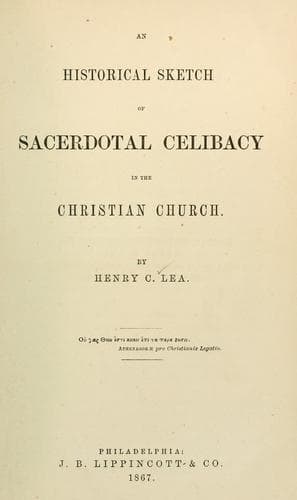
An Historical Sketch of Sacerdotal Celibacy in the Christian ChurchLea, Henry Charles
History
An Historical Sketch of Sacerdotal Celibacy in the Christian Church
Lea, Henry Charles
Catholic Church -- Clergy; Celibacy -- Catholic Church; Church history
damn irrevocably the souls of men, had parodied and travestied the
sacred mysteries and ceremonies, and introduced them in those distant
regions.[40] We are therefore safe in ascribing to Buddhist beliefs
at least a portion of the influence which led the church into the
extravagances of asceticism.
The first official manifestation of this growing tendency, applied
to the relations of the sexes, is to be seen in the legislation with
regard to second marriages. In the passages alluded to above from
Athenagoras and Minucius Felix, the fact is referred to that second
marriages were already regarded as little better than adulterous, while
Justin Martyr denounces them as sinful, in spite of the permission so
freely granted by St. Paul for such unions.[41] Though this opinion
was branded by the church as heretical when it was elevated into an
article of belief by the Montanists and Cathari, or Puritans, and
though even the eminence and piety of Tertullian could not save him
from excommunication when he embraced the doctrine, yet the orthodox
came very near accepting it, for the Council of Neocæsarea, in 314,
forbade priests from honoring with their presence the festivities
customary on such occasions, as those who married a second time were
subject to penance, and that of Laodicea, in 352, deemed it a matter
of indulgence to admit to communion those who contracted such unions,
after they had redeemed their fault by fasting and prayer for a certain
time—a principle repeated by innumerable councils during the succeeding
centuries. So far did this prejudice extend that as late as 484 we
find the Pope, St. Gelasius, obliged to remind the faithful that such
marriages are not to be refused to laymen.[42] It is by no means
impossible that this opposition to repeated wedlock may have arisen, or
perhaps have been intensified, by a similar feeling which existed among
the Pagans, at least with regard to the second marriages of women.
Moreover, in Rome the Flamen Dialis was restricted to a single marriage
with a virgin, and such was the strictness with which this was observed
that as the assistance of the Flaminica, his wife, was necessary to
the performance of some religious rites, he was obliged to resign when
left a widower.[43]
Public-domain text, read in full here on John Shaqi.
Reviews
Reviews
No reviews yet
Be the first to share your thoughts on this work.
Join the Discussion
Join the discussion
Sign in to leave a comment or review.
Sign InorCreate an account