An Historical Sketch of Sacerdotal Celibacy in the Christian Church — John Shaqi
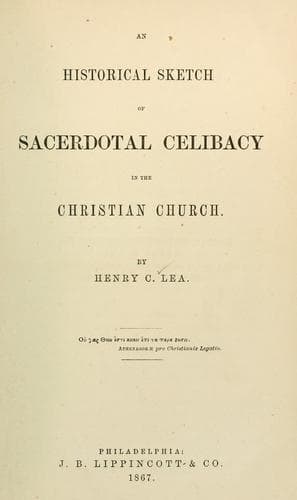
An Historical Sketch of Sacerdotal Celibacy in the Christian ChurchLea, Henry Charles
History
An Historical Sketch of Sacerdotal Celibacy in the Christian Church
Lea, Henry Charles
Catholic Church -- Clergy; Celibacy -- Catholic Church; Church history
Although the church forbore to prohibit absolutely the repetition
of matrimony among the laity, it yet, at an early though uncertain
period, imitated the rule enforced on the Flamen Dialis, and rendered
it obligatory on the priesthood, thus for the first time drawing a
distinct line of separation between the great body of the faithful and
those who officiated as ministers of Christ. It thus became firmly and
irrevocably established that no “digamus” or husband of a second wife
was admissible to holy orders. As early as the time of Tertullian we
find the rule formally expressed by him, and he even assures us that
the whole structure of the church was based upon the single marriages
of its ministers. Indeed, the holy rites came to be regarded as so
entirely incompatible with repetition of wedlock that the Council of
Elvira, in 305, while admitting that in cases of extreme necessity a
layman might administer baptism, is careful to specify that he must not
be a “digamus.”[44]
Yet this restriction on the priesthood was not easily enforced,
and already we begin to hear the complaints, which have followed
uninterruptedly for more than fifteen hundred years, of the evasion
or disregard of the regulations whereby the church has sought to
repress the irrepressible instincts of humanity. In the early part of
the third century Hippolytus, Bishop of Portus, in his enumeration
of the evil ways of Pope Calixtus, taxes the pontiff with admitting
to the priesthood men who had been married twice, and even thrice,
and with permitting priests to marry while in orders. Even the great
apostle of celibacy, St. Jerome, expresses surprise that Oceanus should
object to Carterius, a Spanish bishop, on the ground that he had had a
wife before baptism, and a second one after admission to the church.
The world, he adds, is full of such prelates, not only in the lower
orders but in the episcopate, the digamous members of which exceed in
number the three hundred prelates lately assembled at the Council of
Rimini. Yet this was the formal rule of the church as enunciated in
the Apostolic Constitutions and Canons—bodies of ecclesiastical law
not included, indeed, in the canon of Scripture, but yet so venerable
that their origin was already lost sight of, and they were everywhere
received as authoritative expositions of primitive discipline.[45]
Public-domain text, read in full here on John Shaqi.
Reviews
Reviews
No reviews yet
Be the first to share your thoughts on this work.
Join the Discussion
Join the discussion
Sign in to leave a comment or review.
Sign InorCreate an account