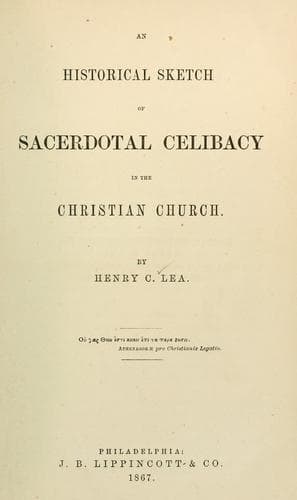
An Historical Sketch of Sacerdotal Celibacy in the Christian ChurchLea, Henry Charles
History
An Historical Sketch of Sacerdotal Celibacy in the Christian Church
Lea, Henry Charles
Catholic Church -- Clergy; Celibacy -- Catholic Church; Church history
The introduction of this entering-wedge is easily explicable. St.
Paul had specified the monogamic condition—“unius uxoris vir”—as a
prerequisite to the diaconate, priesthood, and episcopate, and the
temper of the times was such as to lead irresistibly to this being
taken in its literal sense, rather than to adopt the more rational view
that it was intended to exclude those among the Gentiles who indulged
in the prevalent vice of concubinage, or who among the Jews had fallen
into the sin of polygamy—or those among either race who had taken
advantage, either before or after conversion, of the disgraceful laxity
prevalent with regard to divorces, for, as we learn from Origen, the
rule was by no means obeyed which forbade a divorced person to marry
during the lifetime of the other spouse.[46]
When once this principle was fairly established, and when at the same
time the efforts of the Montanists to render it binding on the whole
body of Christian believers had failed, a distinction was enforced
between the clergy and the laity, as regards the marriage-tie, which
gave to the former an affectation of sanctity, and which was readily
capable of indefinite expansion. It is therefore easy to comprehend
the revival, which shortly followed, of the old Levitical rule
requiring the priesthood to marry none but virgins—a rule which was
early adopted, though it took long to establish it in practice, for
as late as 414 we find Innocent I. complaining that men who had taken
widows to wife were even elevated to the episcopate, and Leo I. devoted
several of his epistles to its enforcement.[47] A corollary to this
speedily followed, which required a priest whose wife was guilty of
adultery to put her away, since further commerce with her rendered him
unfit for the functions of his office; and this again, as subsequent
authorities were careful to point out, afforded a powerful reason for
requiring absolute celibacy on the part of the clergy, for, in view of
the fragility of the sex, no man could feel assured that he was not
subject to this disability, nor could the faithful be certain that
his ministrations were not tainted with irregularity.[48] We thus
reach the state of ecclesiastical discipline at the close of the third
century, as authoritatively set forth in the Apostolical Constitutions
and Canons—bishops and priests allowed to retain the wives which they
may have had before ordination, but not to marry in orders; the lower
grades, deacons, subdeacons, etc., allowed to marry after entering
the church; but all were to be husbands of but one wife, who must be
neither a widow, a divorced woman, nor a concubine.[49]
Public-domain text, read in full here on John Shaqi.
Reviews
Reviews
No reviews yet
Be the first to share your thoughts on this work.
Join the Discussion
Join the discussion
Sign in to leave a comment or review.
Sign InorCreate an account