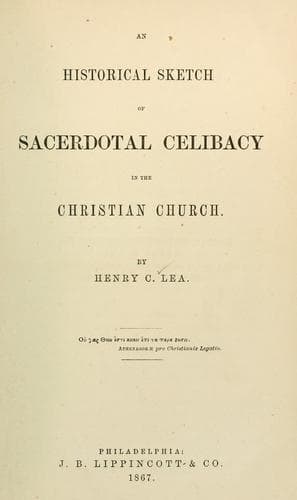
An Historical Sketch of Sacerdotal Celibacy in the Christian ChurchLea, Henry Charles
History
An Historical Sketch of Sacerdotal Celibacy in the Christian Church
Lea, Henry Charles
Catholic Church -- Clergy; Celibacy -- Catholic Church; Church history
Meanwhile, public opinion had moved faster than the canons. Ascetic
sects multiplied and increased, and the highest authorities in the
church could not always resist the contagion. A fresh incitement,
indeed, had been found in the neo-platonic philosophy which arose in
the beginning of the third century. Ammonius Saccas, its founder, was
a Christian, though not altogether orthodox, and his two most noted
disciples, Origen and Plotinus, fairly illustrate the influence which
his doctrines had upon both the Christian and the Pagan world. As to
the latter, neo-platonism borrowed from Christian and Indian as well
as Greek philosophy, evolving out of them all a system of elevated
mysticism in which the senses and the appetites were to be controlled
as severely almost as in the Sankhya and Buddhist schools. Commerce
between the sexes was denounced as a pollution degrading to the soul,
and the best offering which a worshipper could bring to the Deity
was a soul absolutely free from all trace of passion.[50] Although
neo-platonism engaged in a hopeless struggle to stay the advancing
tide of Christianity, and thus became its most active opponent, yet the
lofty asceticism which it inculcated could not be without influence
upon its antagonists, were it only through inflaming the emulation of
those who were already predisposed to regard the mortification of the
flesh as a means of raising the soul to communion with God.[51]
How these motives worked upon an ardent and uncompromising temperament
is seen in the self-sacrifice of Origen, showing how absorbing was
the struggle, and how intense was the conviction that nature must be
conquered at all hazards and by any practicable means, although he
himself afterwards condemned this practical rendering of the text
(_Matt. xix. 12_) on which it was founded. Origen was by no means the
first who had sought in this way to gain the kingdom of heaven, for
he alludes to it as a matter by no means unexampled, and before him
Justin Martyr had chronicled with approbation a similar case. In fact,
there is said to have been an obscene sect which under the name of
Valesians followed the practice and procured proselytes by inflicting
forcible mutilation upon all who were unhappy enough to fall into their
hands; and though their date and locality are unknown to those who
allude to them, it would be rash, in view of similar eccentricities
existing in more modern times, to pronounce them wholly apocryphal.
The repeated prohibitions of the practice, in the canons of the
succeeding century, show how difficult it was to eradicate the belief
that such self-immolation was an acceptable offering to a beneficent
Creator. Sextus Philosophus, an ascetic author of the third century,
whose writings long passed current under the name of Pope Sixtus II.,
did not hesitate openly to advocate it, and though his arguments were
regarded as heretical by the church, they were at least as logical as
Public-domain text, read in full here on John Shaqi.
Reviews
Reviews
No reviews yet
Be the first to share your thoughts on this work.
Join the Discussion
Join the discussion
Sign in to leave a comment or review.
Sign InorCreate an account