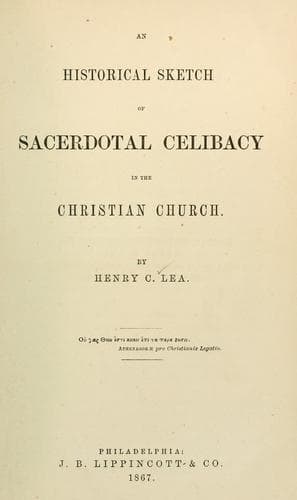
An Historical Sketch of Sacerdotal Celibacy in the Christian ChurchLea, Henry Charles
History
An Historical Sketch of Sacerdotal Celibacy in the Christian Church
Lea, Henry Charles
Catholic Church -- Clergy; Celibacy -- Catholic Church; Church history
pronounces deposition on the bishop or priest who separates himself
from his wife under pretext of religion; while the fiftieth threatens
equally rigorous punishment on the clerk or layman who shall abstain
from marriage, from wine, or from meat, not for the purpose of devoting
himself to piety, but on account of holding them in abomination—such
belief being a slander on the goodness of God, and a calumny on the
perfection of His works.[75] Even a hundred years later there is still
an occasional protest to be heard, showing how the more moderate
section of the church still felt the danger to which she was exposed by
intemperate ascetic zeal, and how narrow was the path which she had to
trace between orthodoxy and heresy. The Fourth Council of Carthage, in
398, prescribing the examination to which all bishops-elect were to be
subjected, specifies for inquiry among other points of faith questions
as to whether the candidate disapproves of marriage, or condemns second
marriages, or prohibits the use of meat.[76] It shows how readily
Manichæism or Catharism might lurk in the asceticism of the most devout.
The tide, however, was fairly on the flood, and the resistance of
the more reasonable among ecclesiastics was unavailing. It is true,
that the influences which were now so powerful could evidently not
be applied to the whole body of believers, as they would only result
in gradual extinction or in lawless licentiousness; but as the
ecclesiastical body was perpetuated by a kind of spiritual generation,
it could, without hazarding a decrease of numbers, be subjected to
regulations which should render obligatory the asceticism which as
yet had been optional. The only wonder, in fact, is that this had
not been earlier attempted. Such a rule, by widening the distinction
between laymen and ecclesiastics, would be grateful to the growing
sacerdotalism which ere long was to take complete possession of the
church. Such a rule, moreover, was not only indicated by the examples
of Buddhism and Manichæism, but had abundant precedent among the Pagans
of the Empire. More than one passage in classical writers show that
abstinence from women was regarded as an essential prerequisite to
certain religious observances, and the existence of this feeling among
the primitive Christians, based upon the injunction of Ahimelech, is
indicated by St. Paul[77]—and this custom, as sacerdotalism developed,
and formalism rendered the life of the minister of the altar a
ceaseless round of daily service, would practically separate husband
and wife. Moreover, much of the Pagan worship subjected its officials
to general restrictions of greater or less severity. Diodorus Siculus
states that the Egyptian priests were permitted to have but one wife,
although unlimited polygamy was allowed to the people; while Chæremon
the Stoic, according to St. Jerome, and Plutarch indicate that they
were obliged to observe entire continence. The castration of the Galli,
Public-domain text, read in full here on John Shaqi.
Reviews
Reviews
No reviews yet
Be the first to share your thoughts on this work.
Join the Discussion
Join the discussion
Sign in to leave a comment or review.
Sign InorCreate an account