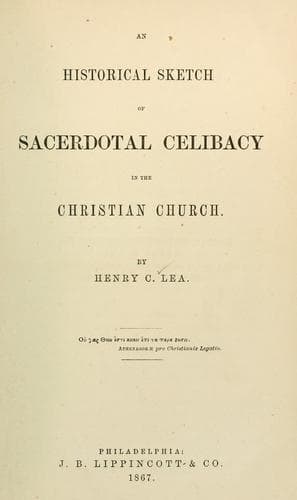
An Historical Sketch of Sacerdotal Celibacy in the Christian Church — John Shaqi
An Historical Sketch of Sacerdotal Celibacy in the Christian ChurchLea, Henry Charles
History
An Historical Sketch of Sacerdotal Celibacy in the Christian Church
Lea, Henry Charles
Catholic Church -- Clergy; Celibacy -- Catholic Church; Church history
the priests of Rhea at Hierapolis, though explained by the myth of
Attys, was evidently only a survival of the fierce asceticism which
counterbalanced the licentiousness of the older Phenician worship.
The rites of the Gaditanian Hercules were conducted by ministers
obliged to observe chastity, and the foot of woman was not permitted
to pollute the sacred precincts of the temple; while the priestesses
of Gea Eurysternus at Ægæ were required to preserve the strictest
celibacy.[78] The hierophants of Demeter in Athens, were obliged to
maintain unsullied continence. The priestesses of the Delphic Apollo,
the Achaian Hera, the Scythian Artemis, and the Thespian Heracles
were virgins. In Africa, those of Ceres were separated from their
husbands with a rigor of asceticism which forbade even a kiss to their
orphaned children; while in Rome the name of Vestal has passed into a
proverb, although it is true that while they were only six or seven in
number, the distinguished honors and privileges accorded to them were
insufficient to induce parents to devote them to the holy service, and
there was difficulty in keeping the ranks filled.[79]
The earliest recorded attempt by the church to imitate these
restrictions, was made in 305 by the Spanish council of Elvira, which
declared, in the most positive manner, that all concerned in the
ministry of the altar should maintain entire abstinence from their
wives under pain of forfeiting their positions. It further endeavored
to put an end to the scandals of the Agapetæ, or female companions
of the clergy, which the rigor of this canon was so well fitted to
increase, by decreeing that no ecclesiastic should permit any woman to
dwell with him, except a sister or a daughter, and even these only
when bound by a vow of virginity.[80] This was simply the legislation
of a local synod, and its canons were not entitled to respect or
obedience beyond the limits of the churches directly represented. Its
action may not improbably be attributed to the commanding influence
of one of its leading members, Osius, Bishop of Cordova, and that
action had no result in inducing the church at large to adopt the new
rule, for some ten years later were held the more important councils
of Ancyra and Neocæsarea, and the absence of any allusion to it in
their proceedings seems to fix for us the discipline of the period in
this respect, at least in the East. By the canons of Ancyra we learn
that marriage in orders was still permitted, as far as the diaconate,
provided the postulant at the time of ordination declared his desire to
enjoy the privilege and asserted his inability to remain single. This
is even less stringent than the rule quoted above from the Apostolic
Constitutions, and proves incontestably that there was no thought of
imposing any restriction upon the intercourse between the married
clergy and their wives. By the council of Neocæsarea it was provided
that a priest marrying in orders should be deposed, but a heavier
Public-domain text, read in full here on John Shaqi.
Reviews
Reviews
No reviews yet
Be the first to share your thoughts on this work.
Join the Discussion
Join the discussion
Sign in to leave a comment or review.
Sign InorCreate an account