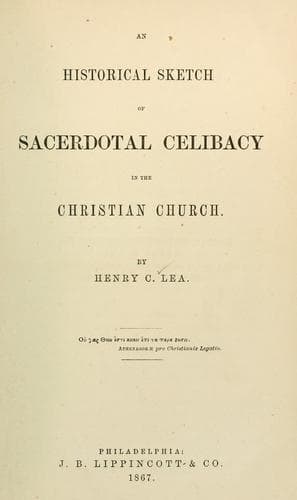
An Historical Sketch of Sacerdotal Celibacy in the Christian ChurchLea, Henry Charles
History
An Historical Sketch of Sacerdotal Celibacy in the Christian Church
Lea, Henry Charles
Catholic Church -- Clergy; Celibacy -- Catholic Church; Church history
punishment was reserved for what was then, in reverse of the standard
of later times, regarded as the greater sin of licentiousness. That no
interference was intended by this with the relations existing between
those who had married in the lower grades and their wives, is shown by
another canon which deprives of his functions any priest who submitted
to the commission of adultery by his wife without separating from
her—being a practical extension of the Levitical rule, now by common
consent adopted as a portion of ecclesiastical discipline.[81] Yet,
even in the East, there was a growing tendency to more rigid asceticism
than this, for, about the same period, we find Eusebius stating that it
is becoming in those who are engaged in the ministry of God, to abstain
from their wives, though his argument in justification of this is
based upon the multiplicity of occupation, which in civilized society
rendered it desirable for those enlisted in the service of the church
to be relieved from family cares and anxieties.[82]
III.
THE COUNCIL OF NICÆA.
Thus far the church had grown and strengthened without any recognized
head or acknowledged legislative power. Each patriarch or metropolitan,
surrounded by his provincial synod, established regulations for his own
region, with no standard but the canon of Scripture, being responsible
only to the opinion of his compeers, who might refuse to receive
his clergy to communion. Under this democratic autonomy the church
had outlived persecution, had repudiated and cast out innumerable
successive heresies, and, thanks to external pressure, had managed to
preserve its unity. The time, however, had now come for a different
order of things. Constantine, following the dictates of his unerring
political sagacity, allied himself with the Christians and professed
conversion; and Christianity, powerful even when merely existing on
sufferance, became the religion of the state. As such, the maintenance
of its unity was a political necessity, to accomplish which required
some central power entitled to general respect and implicit obedience.
The subtle disputations concerning the fast-spreading Arian heresy
were not likely to be stilled by the mere _ipse dixit_ of any of
the Apostolic Sees, nor by the secular wisdom of crown lawyers and
philosophic courtiers. A legislative tribunal, which should be at
once a court of last appeal and a senate empowered to enact laws of
binding force, as the final decisions of the Church Universal, was
not an unpromising suggestion. Such an assemblage had hitherto been
impossible, for the distances to be traversed and the expenses of
the journey would have precluded an attendance sufficiently numerous
to earn the title of Œcumenic; but an imperial rescript which put
the governmental machinery of posts at the service of the prelates
could smooth all difficulties, and enable every diocese to send its
representative. In the year 325, therefore, the FIRST GENERAL COUNCIL
assembled at Nicæa.
Public-domain text, read in full here on John Shaqi.
Reviews
Reviews
No reviews yet
Be the first to share your thoughts on this work.
Join the Discussion
Join the discussion
Sign in to leave a comment or review.
Sign InorCreate an account