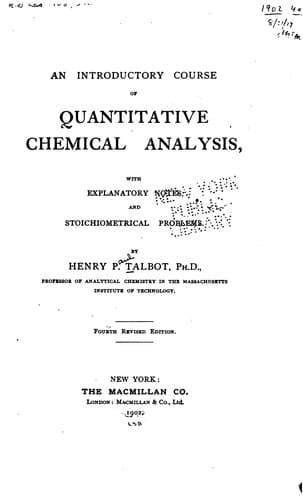
An Introductory Course of Quantitative Chemical Analysis: With Explanatory NotesTalbot, Henry Paul
Science
An Introductory Course of Quantitative Chemical Analysis: With Explanatory Notes
Talbot, Henry Paul
Chemistry, Analytic -- Quantitative
In an instructional laboratory appreciable errors should be reported
to the instructor in charge for his consideration.
When the highest accuracy is desired, the weights may be calibrated
and corrections applied. A calibration procedure is described in a
paper by T.W. Richards, !J. Am. Chem. Soc.!, 22, 144, and in many
large text-books.
Weights are inevitably subject to corrosion if not properly protected
at all times, and are liable to damage unless handled with great care.
It is obvious that anything which alters the weight of a single piece
in an analytical set will introduce an error in every weighing made
in which that piece is used. This source of error is often extremely
obscure and difficult to detect. The only safeguard against such
errors is to be found in scrupulous care in handling and protection
on the part of the analyst, and an equal insistence that if several
analysts use the same set of weights, each shall realize his
responsibility for the work of others as well as his own.
BURETTES
A burette is made from a glass tube which is as uniformly cylindrical
as possible, and of such a bore that the divisions which are etched
upon its surface shall correspond closely to actual contents.
The tube is contracted at one extremity, and terminates in either a
glass stopcock and delivery-tube, or in such a manner that a piece of
rubber tubing may be firmly attached, connecting a delivery-tube of
glass. The rubber tubing is closed by means of a glass bead. Burettes
of the latter type will be referred to as "plain burettes."
The graduations are usually numbered in cubic centimeters, and the
latter are subdivided into tenths.
One burette of each type is desirable for the analytical procedures
which follow.
PREPARATION OF A BURETTE FOR USE
The inner surface of a burette must be thoroughly cleaned in order
that the liquid as drawn out may drain away completely, without
leaving drops upon the sides. This is best accomplished by treating
the inside of the burette with a warm solution of chromic acid in
concentrated sulphuric acid, applied as follows: If the burette is of
the "plain" type, first remove the rubber tip and force the lower
end of the burette into a medium-sized cork stopper. Nearly fill the
burette with the chromic acid solution, close the upper end with a
cork stopper and tip the burette backward and forward in such a way
as to bring the solution into contact with the entire inner surface.
Remove the stopper and pour the solution into a stock bottle to be
kept for further use, and rinse out the burette with water several
times. Unless the water then runs freely from the burette without
leaving drops adhering to the sides, the process must be repeated
(Note 1).
Public-domain text, read in full here on John Shaqi.
Reviews
Reviews
No reviews yet
Be the first to share your thoughts on this work.
Join the Discussion
Join the discussion
Sign in to leave a comment or review.
Sign InorCreate an account