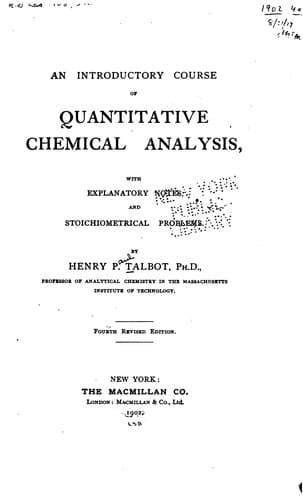
An Introductory Course of Quantitative Chemical Analysis: With Explanatory NotesTalbot, Henry Paul
Science
An Introductory Course of Quantitative Chemical Analysis: With Explanatory Notes
Talbot, Henry Paul
Chemistry, Analytic -- Quantitative
The following paragraphs should be read carefully and thoughtfully. A
prime essential for success as an analyst is attention to details and
the avoidance of all conditions which could destroy, or even lessen,
confidence in the analyses when completed. The suggestions here given
are the outcome of much experience, and their adoption will tend to
insure permanently work of a high grade, while neglect of them will
often lead to disappointment and loss of time.
ACCURACY AND ECONOMY OF TIME
The fundamental conception of quantitative analysis implies a
necessity for all possible care in guarding against loss of material
or the introduction of foreign matter. The laboratory desk, and all
apparatus, should be scrupulously neat and clean at all times. A
sponge should always be ready at hand, and desk and filter-stands
should be kept dry and in good order. Funnels should never be allowed
to drip upon the base of the stand. Glassware should always be
wiped with a clean, lintless towel just before use. All filters and
solutions should be covered to protect them from dust, just as far as
is practicable, and every drop of solution or particle of precipitate
must be regarded as invaluable for the success of the analysis.
An economical use of laboratory hours is best secured by acquiring
a thorough knowledge of the character of the work to be done before
undertaking it, and then by so arranging the work that no time shall
be wasted during the evaporation of liquids and like time-consuming
operations. To this end the student should read thoughtfully not only
the !entire! procedure, but the explanatory notes as well, before
any step is taken in the analysis. The explanatory notes furnish, in
general, the reasons for particular steps or precautions, but they
also occasionally contain details of manipulation not incorporated,
for various reasons, in the procedure. These notes follow the
procedures at frequent intervals, and the exact points to which they
apply are indicated by references. The student should realize that a
!failure to study the notes will inevitably lead to mistakes, loss of
time, and an inadequate understanding of the subject!.
All analyses should be made in duplicate, and in general a close
agreement of results should be expected. It should, however, be
remembered that a close concordance of results in "check analyses" is
not conclusive evidence of the accuracy of those results, although the
probability of their accuracy is, of course, considerably enhanced.
The satisfaction in obtaining "check results" in such analyses must
never be allowed to interfere with the critical examination of the
procedure employed, nor must they ever be regarded as in any measure a
substitute for absolute truth and accuracy.
Public-domain text, read in full here on John Shaqi.
Reviews
Reviews
No reviews yet
Be the first to share your thoughts on this work.
Join the Discussion
Join the discussion
Sign in to leave a comment or review.
Sign InorCreate an account