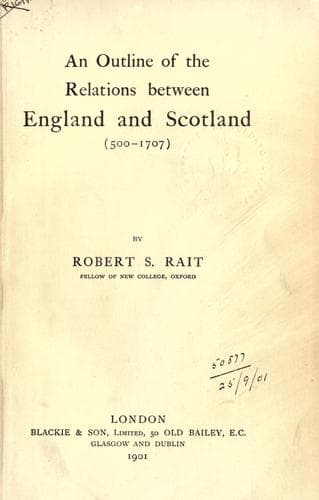
An Outline of the Relations between England and Scotland (500-1707)Rait, Robert S. (Robert Sangster)
History
An Outline of the Relations between England and Scotland (500-1707)
Rait, Robert S. (Robert Sangster)
England -- Foreign relations -- Scotland; Scotland -- Foreign relations -- England
When Alexander III was killed, on the 19th March, 1285-86, the relations
between England and Scotland were such that Edward I was amply justified
in looking forward to a permanent union. Since the ill-fated invasion of
William the Lion in 1174, there had been no serious warfare between the
two countries, and in recent years they had become more and more
friendly in their dealings with each other. The late king had married
Edward's sister, Margaret, and the child-queen was her grand-daughter;
Alexander and Margaret had been present at the English King's coronation
in 1274; and, in addition to these personal connections, Scotland had
found England a friend in its great final struggle with the Danes. The
misfortunes which had overtaken Scotland in the premature deaths[41] of
Alexander and his three children might yet prove a very real blessing,
if they prepared the way for the creation of a great island kingdom,
which should be at once free and united. The little Margaret, the Maid
of Norway, Edward's grand-niece, had been acknowledged heir to the
throne of her grandfather, in February, 1283-84, and on his death her
succession was admitted. The Great Council met at Scone in April, 1286,
and appointed six Guardians of the Kingdom. It was no easy task which
was entrusted to them, for the claim of a child and a foreigner could
not but be disputed by the barons who stood nearest to the throne. The
only rival who attempted to rebel was Robert Bruce of Annandale, who had
been promised the succession by Alexander II, and had been disappointed
of the fulfilment of his hopes by the birth of the late king in 1241.
The deaths of two of the guardians added to the difficulties of the
situation, and it was with something like relief that the Scots heard
that Eric of Norway, the father of their queen, wished to come to an
arrangement with Edward of England, in whose power he lay. The result of
Eric's negotiations with Edward was that a conference met at Salisbury
in 1289, and was attended, on Edward's invitation, by four Scottish
representatives, who included Robert Bruce and three of the guardians.
Such were the troubles of the country that the Scots willingly acceded
to Edward's proposals, which gave him an interest in the government of
Scotland, and they heard with delight that he contemplated the marriage
of their little queen to his son Edward, then two years of age. The
English king was assured of the satisfaction which such a marriage would
give to Scotland, and the result was that, by the Treaty of Brigham, in
1290, the marriage was duly arranged. Edward had previously obtained the
necessary dispensation from the pope.
Public-domain text, read in full here on John Shaqi.
Reviews
Reviews
No reviews yet
Be the first to share your thoughts on this work.
Join the Discussion
Join the discussion
Sign in to leave a comment or review.
Sign InorCreate an account